
Guide · checked November 2026
Radiology report templates and structured reporting
Radiology report templates give a report fixed headings, a consistent order and, at best, standard terms; the RCR's 2025 reporting standards encourage structured templates where suitable, the European Society of Radiology endorses the move to structured reporting, and the RCR warns that a template must not imply scrutiny that did not happen.
Three levels of structure
The ESR's 2018 paper on structured reporting describes three levels:
- Structured layout: paragraphs and subheadings, such as technique, findings and conclusion.
- Consistent organisation: a logical internal order that covers every relevant area, for example all the compartments of a knee MRI.
- Standardised language: the consistent use of defined terms, such as the RadLex vocabulary.
Most departments using templates are at the first or second level. The third is what makes reports easy to search, compare and reuse.
What the RCR says
The RCR's Standards for interpretation and reporting of imaging investigations (third edition, October 2025) say reporting style can vary with clinical context but should put clarity and clinical relevance first. Structured templates are encouraged where suitable and help with complete data collection, for example for RECIST in research, National Cancer Registry data, audit and quality assurance, and trauma reporting. Templates may be adapted to drop fields that do not apply, and structured or AI-generated formats should not be used to imply a degree of scrutiny that has not taken place.
The same standards ask for a conclusion that is short and actionable, answers the clinical question and makes clear, specific recommendations, avoiding blanket phrases such as "clinical correlation advised". The Quality Standard for Imaging 2026 (XR-706) expects a service's reporting policy to include agreed reporting formats.
Where templates come from
The ESR paper describes RSNA's radreport.org library, built with subspecialty societies and coded with RadLex terms, where ESR and RSNA members can propose and rate templates and a joint panel reviews them. It also points to the IHE Management of Radiology Report Templates (MRRT) profile, which sets a common HTML5 format for templates and the roles of the systems that create, manage and use them. Subspecialty societies and screening programmes publish their own. In practice, most departments adapt an existing template locally rather than write one from scratch.
Benefits and risks
The ESR says a standard structure works like a checklist, so relevant areas are addressed; standard terms reduce ambiguity; and structured content allows automated data mining and could be part of quality audits. It is also frank about the problems: products have not reached a good enough level of usability, deciding what each report should contain is hard, and vendors often store structured content in proprietary formats.
Brady's 2017 review adds a clinical risk: a reader focused on the relevant section may miss an unexpected finding elsewhere.
Checking templated reports
- Placeholders left unfilled, such as brackets, asterisks or [laterality].
- Default "normal" text that contradicts a positive finding later in the report.
- Irrelevant fields left in instead of removed, which the RCR allows.
- A conclusion that repeats the body without answering the question.
- Incidental findings in the body with no recommendation in the conclusion.
What a template does not do
- It does not prove each item was examined; a filled field is not a look.
- Structured does not mean longer: irrelevant negatives can bury what matters.
- Not every examination needs one; the ESR leaves that question open.
Where RadQA fits
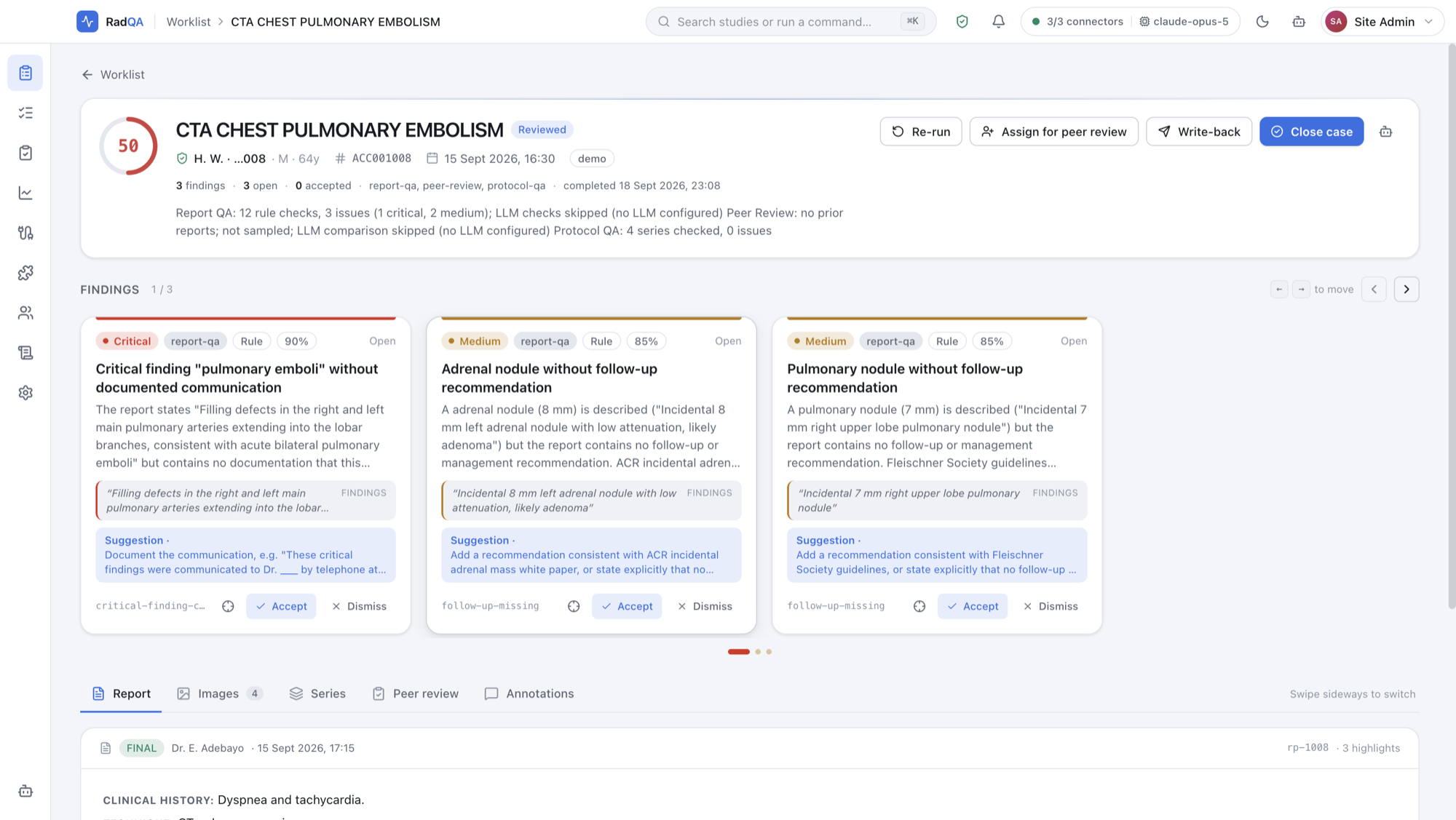
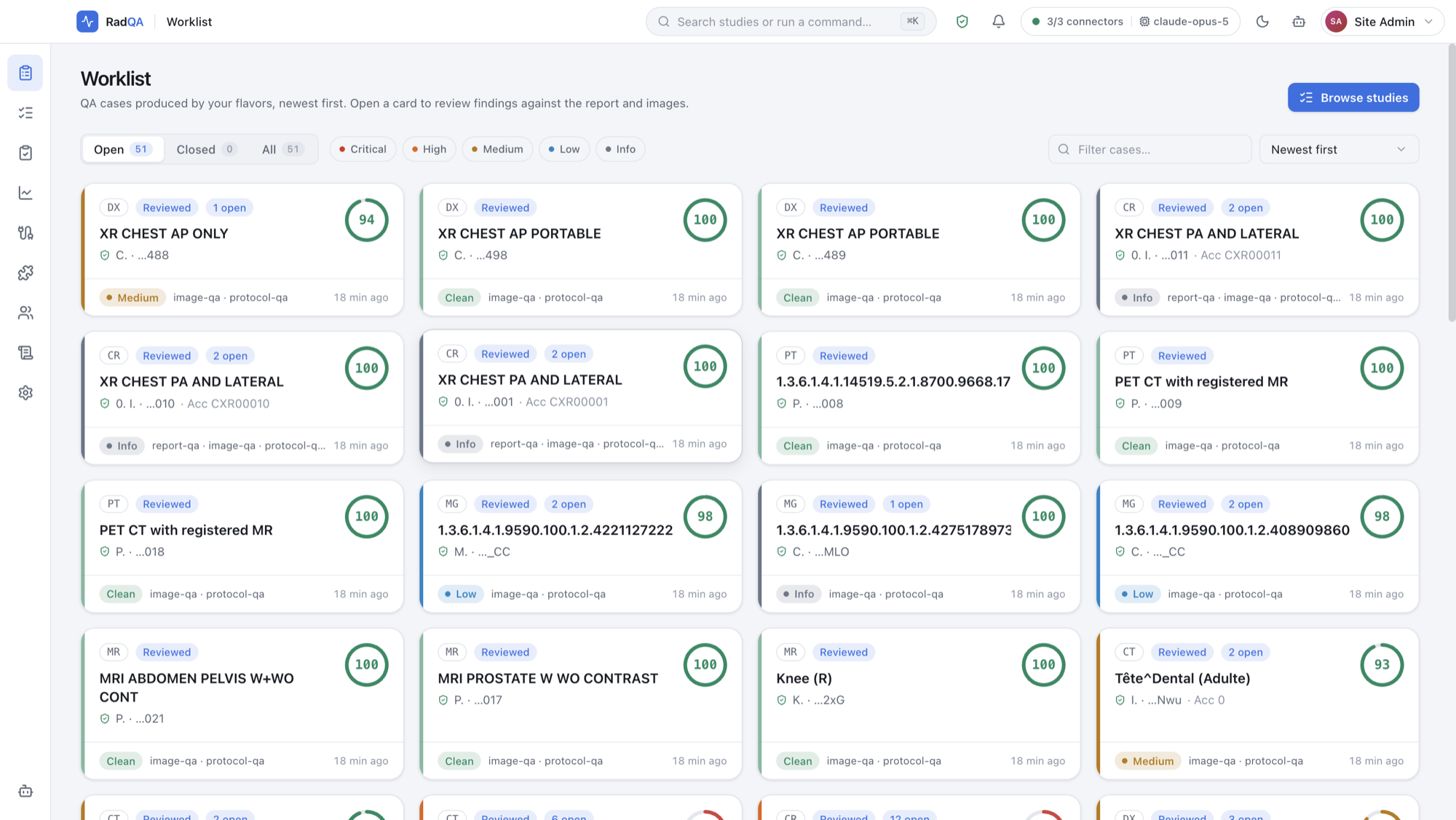
RadQA does not supply or manage report templates. Its report QA checks what templates tend to leave behind: placeholder text such as brackets, asterisks, XXX or [laterality] still in the report, and "normal study" boilerplate alongside positive findings. It also flags a missing or too-short impression, an impression that contradicts the findings and incidental findings without a follow-up recommendation, quoting the sentence each finding came from.
RadQA is a pilot. It is a quality-assurance assistant, not a diagnostic device, and it does not replace radiologist reporting or clinical judgement.
 RadQA: AI quality assurance for radiologyWatch the demo on synthetic data, then see how it works →
Questions
Does the RCR recommend structured reporting?
Its 2025 reporting standards encourage structured templates where suitable and say templates may be adapted to omit fields that are not relevant.
Where can I find radiology report templates?
RSNA's radreport.org library, described in the ESR's 2018 paper, plus subspecialty society and screening programme templates.
Do structured reports reduce errors?
They improve completeness and clarity, according to the ESR and Brady's review, but Brady notes readers may miss unexpected findings outside the section they focus on.
Sources
Official pages, checked November 2026. Guidance changes, so check the current version before you rely on it.
- RCR: Standards for interpretation and reporting of imaging investigations, 3rd edition (October 2025)
- ESR paper on structured reporting in radiology, Insights into Imaging (February 2018)
- CoR and RCR: Quality Standard for Imaging 2026, version 1.0
- Brady AP. Error and discrepancy in radiology: inevitable or avoidable? Insights into Imaging 2017;8:171–182
General information for healthcare managers and clinical teams, checked November 2026. It is not legal, regulatory or clinical advice; follow the current official guidance and your organisation's own policies. No patient data is used in these examples. RadQA is a quality-assurance assistant for imaging departments. It is not a diagnostic device and does not replace radiologist reporting or clinical judgement. Validate against your own systems and local governance before production use.