Guide · checked November 2026
Radiology report addendum: when and how to issue one
Add an addendum when an issued report needs correcting or adding to after someone else may have read it; the RCR's 2025 standards want changes after a report has been accessed to go through version control with notification, and the 2022 Academy of Medical Royal Colleges recommendations say an addendum that may alter management should go to the referrer at once with an ADDITION alert, plus a call if immediate action is needed.
Typo fix or addendum?
The RCR's Standards for interpretation and reporting of imaging investigations (third edition, October 2025) encourage organisations that can to hold a report for a brief, controlled delay, for example up to two minutes, before others can see it, solely so the reporter can correct typing errors. Once another party has accessed the report, any change should go through formal version control, with the amendment clearly documented and all relevant users notified.
The same standards ask providers for a standard operating procedure on communicating addenda, including those from later reviews and MDT meetings. The Quality Standard for Imaging 2026 (XR-706) expects the reporting policy to include a system that makes sure amendments are issued within set timescales. For interventional procedures, later diagnostic conclusions should be captured separately or as an addendum.
Significant addenda
- Notify the referrer with an ADDITION alert via a digital platform as soon as the addendum is complete.
- Add a phone call if immediate intervention is needed, and record who received it in the report or patient record.
- A results coordination team can make that call, telling the clinical team the addended report is ready.
- An electronic alert may not be needed if the verbal communication was made and documented, subject to local governance.
The AoMRC's Alerts and notification of imaging reports (October 2022) defines a significant addendum as one where findings are interpreted differently from a preceding report of the same examination in a way that could cause immediate harm, or adverse outcomes if not acted on in time. It is separate from an addendum that adds findings without changing management. It can also reduce the significance of the original: one example is a CT liver after ablation where a high-attenuation area first reported as possible residual tumour is shown on the unenhanced series to be a haematoma. The earlier report may be preliminary or verified, and addenda from quality and governance processes count too.
Wording it
Say what has changed and why, so the addendum makes sense on its own, and keep it factual. The RCR's 2025 standards ask reporters to keep comments about others relevant, factual and non-judgemental. Where a later study reveals a discrepancy, the RCR's sample REALM correspondence suggests a short, non-judgemental addendum to the primary report that points the reader to the later scan and report by date. Where there is no later report to point to, the REALM standards suggest a non-judgemental informative addendum, ideally added by the original reporter.
Who to tell
- The referrer, by alert and, where needed, by phone.
- The original reporter: the RCR says a radiologist giving a second opinion should always make the primary reporter aware of an addendum.
- The REALM chair, if the case has learning value.
- The responsible clinician, if the discrepancy was an error and the patient may have come to significant harm; the RCR says the duty of candour then applies and it is for that clinician to inform the patient.
MDT second opinions that differ significantly from the original report should be recorded on the RIS straight away, the RCR adds, so the referrer is not left with two opinions in two systems.
What an addendum is not
- Not a silent edit: once a report has been read, changes need version control and notification.
- Not always bad news: an addendum that downgrades a finding can be significant too.
- Not an admission of error: many discrepancies are only visible with hindsight.
Where RadQA fits
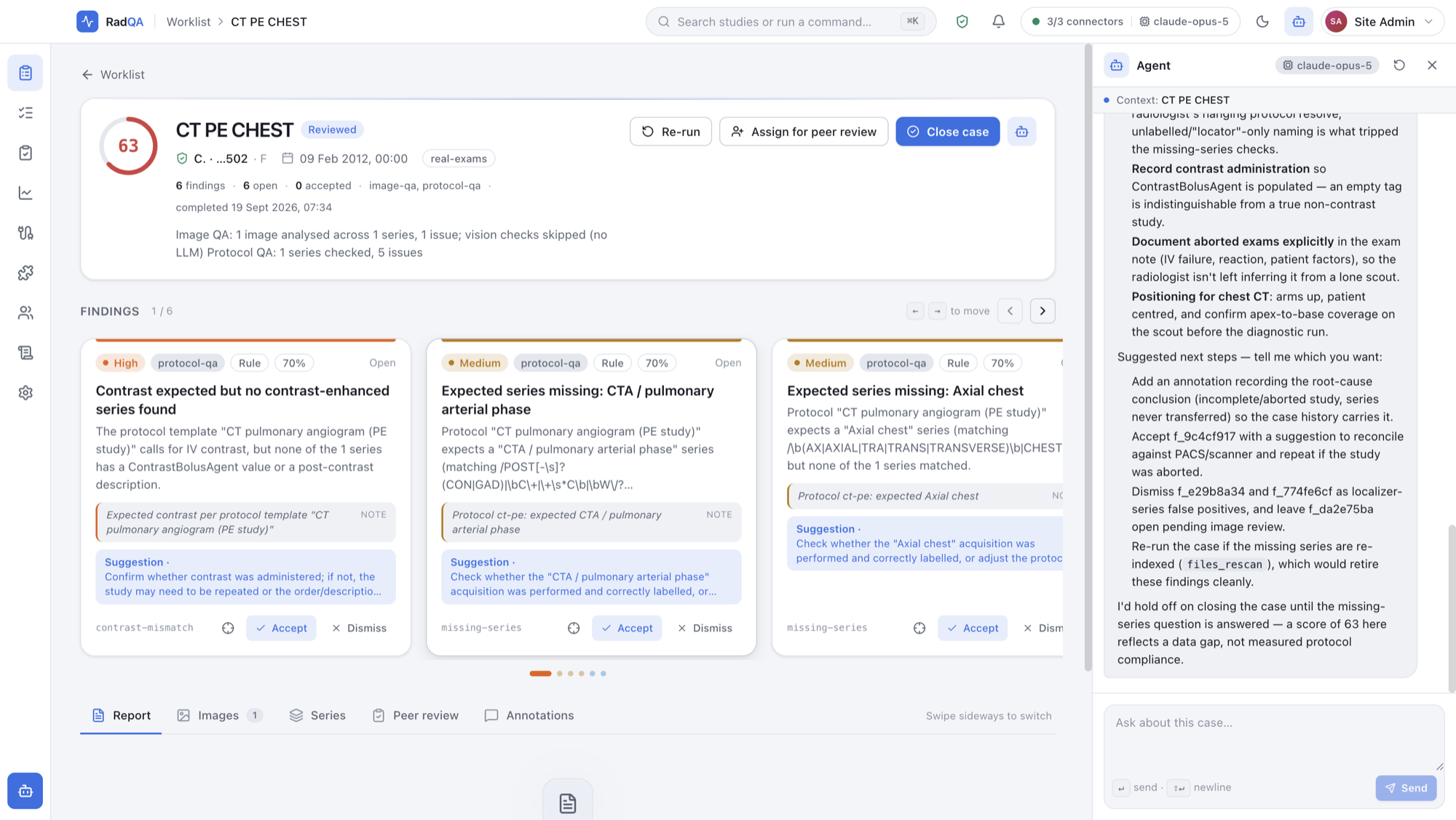
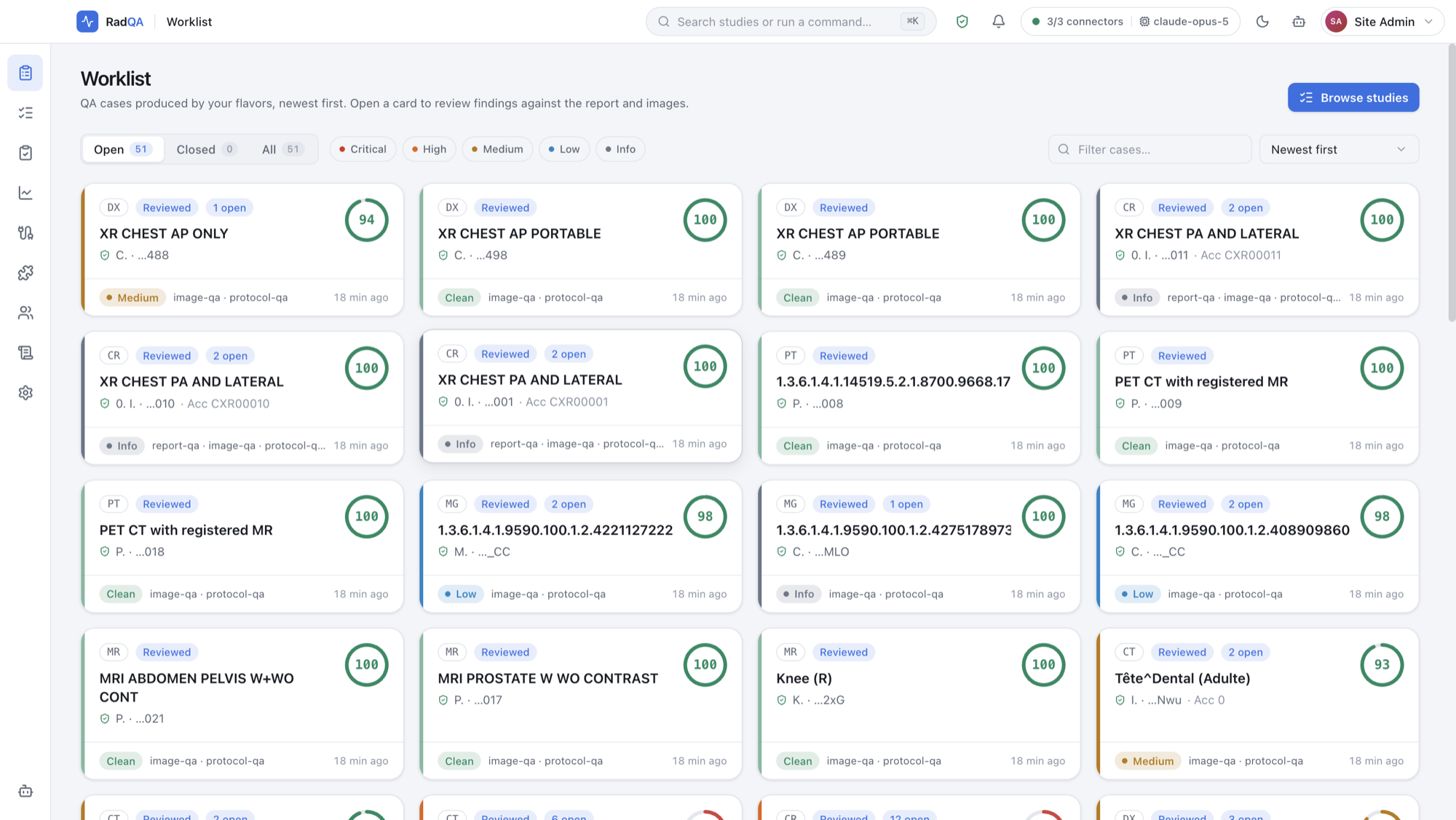
When a person accepts a report QA finding, they can attach proposed addendum wording, and the RadQA assistant can draft it. Sending an addendum back to the source system, as a FHIR DiagnosticReport addendum or an HL7 ORU message, needs the write-back permission and an explicit approval each time, the text is shown before it is sent, and the action is recorded in the audit log.
RadQA does not send ADDITION alerts or phone referrers. RadQA is a pilot. It is a quality-assurance assistant, not a diagnostic device, and it does not replace radiologist reporting or clinical judgement.
 RadQA: AI quality assurance for radiologyWatch the demo on synthetic data, then see how it works →
Questions
What is a significant addendum in radiology?
In the AoMRC's 2022 recommendations, one where findings are interpreted differently from the preceding report of the same examination in a way that could cause harm if not acted on in time.
Can a radiology report be changed after it is issued?
The RCR's 2025 standards suggest a short controlled delay, for example up to two minutes, for typo fixes; after another party has accessed the report, changes go through version control with notification.
Who should be told about an addendum?
The referrer, by ADDITION alert and by phone if immediate action is needed, and the original reporter, whom the RCR says should always be made aware.
Sources
Official pages, checked November 2026. Guidance changes, so check the current version before you rely on it.
- RCR: Standards for interpretation and reporting of imaging investigations, 3rd edition (October 2025)
- AoMRC / RCR: Alerts and notification of imaging reports (October 2022)
- RCR: Standards for radiology events and learning meetings (January 2020)
- CoR and RCR: Quality Standard for Imaging 2026, version 1.0
General information for healthcare managers and clinical teams, checked November 2026. It is not legal, regulatory or clinical advice; follow the current official guidance and your organisation's own policies. No patient data is used in these examples. RadQA is a quality-assurance assistant for imaging departments. It is not a diagnostic device and does not replace radiologist reporting or clinical judgement. Validate against your own systems and local governance before production use.