Guide · checked November 2026
Incidental findings in radiology: communication and follow-up
When a scan shows a significant finding nobody was looking for, the report should say so plainly with a specific recommendation, an alert should go to the referrer if the finding fits an alert category, and the organisation, not only radiology, needs a fail-safe that finds reports that were not read, acknowledged and acted on.
What the HSSIB investigation found
The Healthcare Safety Investigation Branch (now HSSIB) investigated failures in communication or follow-up of unexpected significant radiological findings. Its reference case was a chest X-ray from an emergency attendance, reported 12 days later as showing a possible lung cancer. The letter to the treating team was not received and the email was opened but not acted on; the patient's GP picked up the finding three months later.
The investigation found wide variation in how these findings are communicated and acknowledged, that opening a report or generating a read receipt is an unreliable form of acknowledgement, and that there is no nationally agreed list of what counts as an unexpected significant finding. It reported 41 serious incidents between April 2017 and May 2018 involving delayed lung cancer diagnosis from unactioned radiological findings, and recommended that the RCR develop principles for which findings trigger alerts and a simplified national framework for alert codes.
What the report should say
- Mention incidental findings that matter and explain them, but leave out irrelevant ones, which the RCR says can detract from the report and generate unnecessary tests.
- Follow accepted guidelines for incidental findings, reference them where helpful, or say when no further action is needed.
- Make clear, specific recommendations rather than blanket phrases such as "clinical correlation advised".
- Make sure clinically important incidental findings are communicated appropriately.
- Review all acquired images, including scout images and non-target areas.
These points come from the RCR's Standards for interpretation and reporting of imaging investigations (third edition, October 2025).
Alerts and the fail-safe
- Three alert categories: new cancer diagnoses or recurrences (code CANCER), time-critical findings (CRITICAL) and significant addenda (ADDITION). Organisations may add more under local governance.
- The healthcare organisation must have a fail-safe that identifies reports not read, acknowledged and acted on, and a mechanism to follow them up: a digital system, a results coordination team, or both. It should not fall to the imaging department alone.
- Every referral needs a valid contact, including out of hours.
- Referrers must make sure reports are read, acknowledged and acted on; a team that receives an alert for a patient no longer in its care should act on it or redirect it.
- Escalating an unacknowledged alert after 48 hours is described as reasonable, depending on clinical urgency.
These are the Academy of Medical Royal Colleges' Alerts and notification of imaging reports (October 2022). The Quality Standard for Imaging 2026 (XR-707) asks for a protocol on alerting, acknowledgement, non-acknowledgement, escalation and out-of-hours alerts, and for a way for the radiographer to alert the reporter to untoward findings seen at the time of imaging.
Auditing it
The RCR's AuditLive template on radiology alerts [QSI XR-510] sets a 100% target for alerted reports being read and acted on, with any decision that no action is needed documented in the notes. It suggests auditing every alert by type over a week, extended to at least 25 patients. Pair it with a check of report text: findings that usually need follow-up but carry no recommendation.
Common misreadings
- Not every incidental finding needs an alert: the national categories are cancer, time-critical findings and significant addenda.
- A read receipt is not acknowledgement, as HSSIB found.
- The fail-safe is not only radiology's job; the AoMRC places it on the organisation.
Where RadQA fits
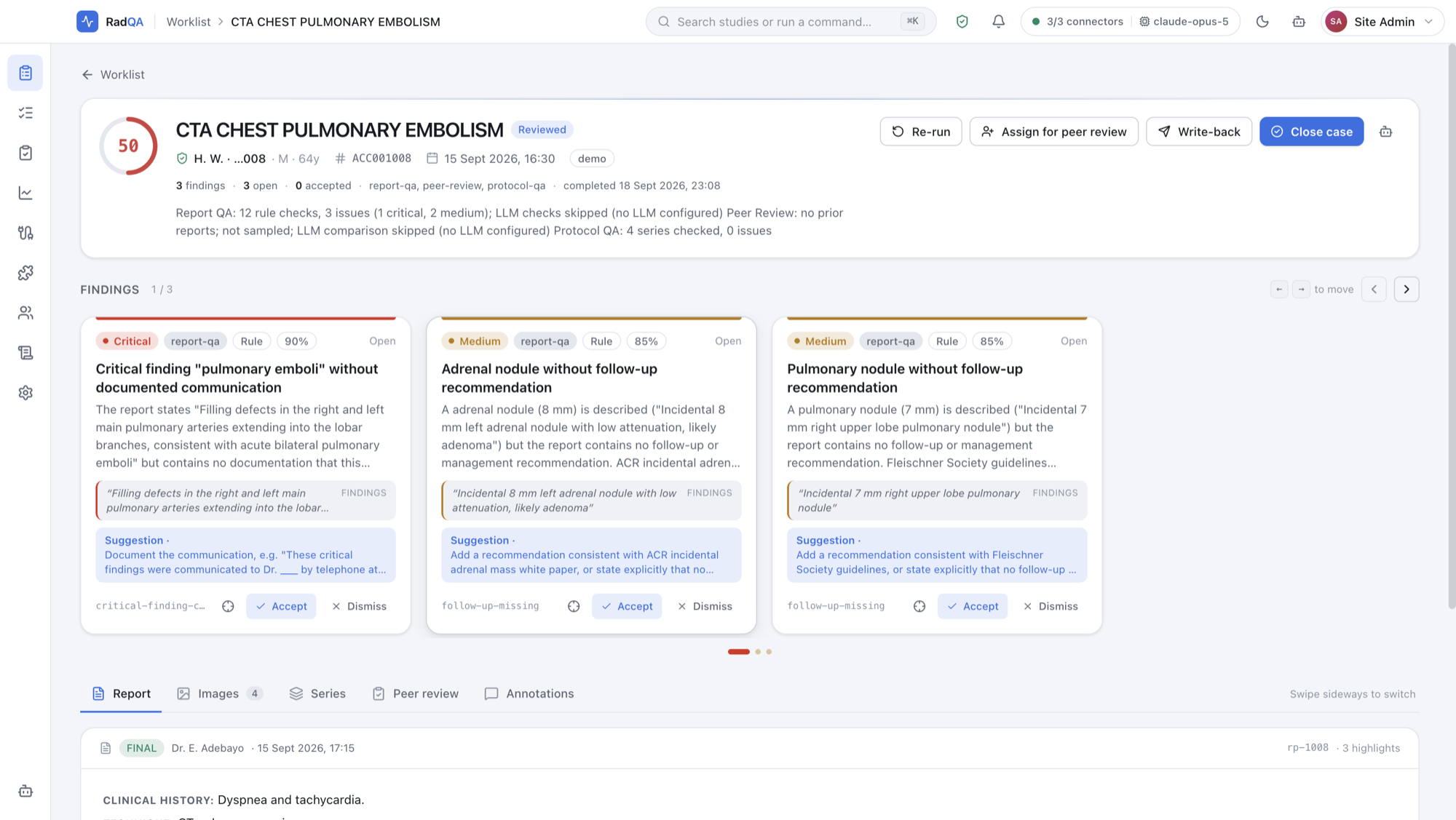
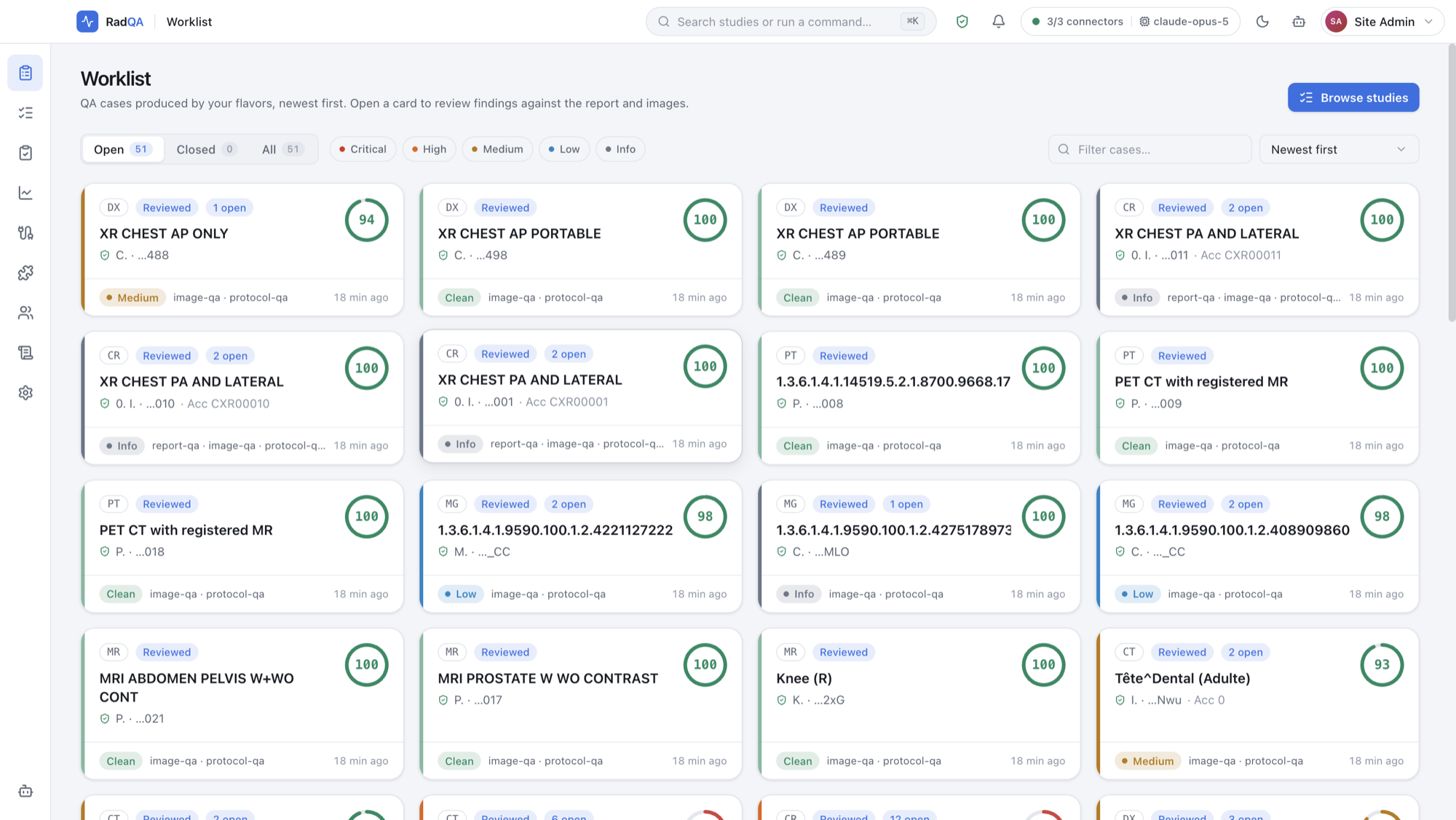
RadQA's report QA flags a report that describes an incidental finding which usually carries guideline-based follow-up (a pulmonary, adrenal or thyroid nodule, an indeterminate renal lesion, a large ovarian cyst, a pancreatic cyst or an aortic aneurysm) but contains no recommendation, and names the guideline family that typically applies. Those names include US guidance such as the Fleischner Society and ACR white papers, so check them against the guidance your department uses. It also flags critical findings with no documented communication, quoting the sentence in each case.
RadQA does not send alerts, track acknowledgement or follow up patients. RadQA is a pilot. It is a quality-assurance assistant, not a diagnostic device, and it does not replace radiologist reporting or clinical judgement.
 RadQA: AI quality assurance for radiologyWatch the demo on synthetic data, then see how it works →
Questions
What is an unexpected significant finding?
HSSIB found there is no nationally agreed list. The AoMRC's 2022 recommendations define alert categories: new cancer or recurrence, time-critical findings and significant addenda.
Who is responsible for acting on an incidental finding?
The AoMRC says referrers must ensure reports are read, acknowledged and acted on, and organisations must run a fail-safe to find those that are not.
When should an unacknowledged alert be escalated?
The AoMRC describes a 48-hour interval before escalation as reasonable, varying with clinical urgency and agreed locally.
Sources
Official pages, checked November 2026. Guidance changes, so check the current version before you rely on it.
- HSSIB (then HSIB): Failures in communication or follow-up of unexpected significant radiological findings
- AoMRC / RCR: Alerts and notification of imaging reports (October 2022)
- RCR: Standards for interpretation and reporting of imaging investigations, 3rd edition (October 2025)
- CoR and RCR: Quality Standard for Imaging 2026, version 1.0
- RCR AuditLive: Assessing effectiveness of radiology alerts [QSI Ref: XR-510]
General information for healthcare managers and clinical teams, checked November 2026. It is not legal, regulatory or clinical advice; follow the current official guidance and your organisation's own policies. No patient data is used in these examples. RadQA is a quality-assurance assistant for imaging departments. It is not a diagnostic device and does not replace radiologist reporting or clinical judgement. Validate against your own systems and local governance before production use.