Guide · checked November 2026
Radiology audit ideas, with templates and standards
Good radiology audit topics have a published standard behind them, such as whether reports are read, whether alerts are acted on, turnaround against NHS England targets, REALM participation, image quality and report content; the RCR's AuditLive library has templates covering over 100 radiology topics, many linked to Quality Standard for Imaging (QSI) items.
Where to find templates
AuditLive is the RCR's library of clinical radiology audit templates. It can be filtered by topic (including A&E, AI, breast, CT, MRI, ultrasound, paediatrics, patient safety and QSI) and by year, and many templates carry a QSI reference. Templates are submitted by members and Fellows; the RCR says it does not verify them, so check each against current guidance. The terms limit use to professional, educational and non-commercial use within clinical radiology in the UK.
There is a legal reason to keep the programme going. IR(ME)R 2017 regulation 7 requires the employer's procedures to provide for clinical audit and, since 1 October 2024, for taking appropriate action on the results.
Ten audit ideas
- Are reports read? AuditLive's template [QSI XR-508] sets a 100% target for documented acknowledgement and suggests about 50 patients, 5 to 10 per clinical area.
- Are alerts acted on? AuditLive's alerts template [QSI XR-510] expects 100% of alerted reports to be read and appropriately acted on, auditing all alerts by type over a week, extended to at least 25 patients.
- Significant addenda: were addenda that could change management flagged with an ADDITION alert, as the 2022 Academy of Medical Royal Colleges recommendations ask?
- Turnaround: verified reports against NHS England's 2023 targets by urgency, including the four-week maximum.
- Incidental findings: do reports describing a finding that usually needs follow-up carry a specific recommendation, or say none is needed, as the RCR's 2025 reporting standards expect?
- Proofreading: wrong-side attribution, missed negatives and word substitution, which the same standards name as preventable by careful proofreading.
- REALM participation: at least six meetings a year, 50% attendance and one case contributed per radiologist, from the RCR's 2020 standards.
- Image quality: AuditLive has examples such as the quality of special care baby unit portable chest X-rays [QSI XR-503, XR-505] and image quality in diagnostic breast ultrasound [QSI XR-503].
- Request quality: AuditLive has a template on the adequacy of clinical information on CT requests after major trauma.
- Structured report content: AuditLive has examples on standardising breast MRI staging reports [QSI XR-508].
Running it well
Set the standard and target before you collect data, and write down how cases are chosen. Present results by cause and modality rather than by individual, and agree the actions and an owner in the same meeting. Re-audit with the same method so you can show whether things changed; that second round is what turns a snapshot into an audit cycle and gives the evidence QSI assessors look for.
Common traps
- A template is not an RCR standard: AuditLive templates are member submissions the RCR does not verify.
- One round is not a cycle: without a re-audit the loop is open.
- Audit without action no longer meets IR(ME)R regulation 7 as amended in 2024.
Where RadQA fits
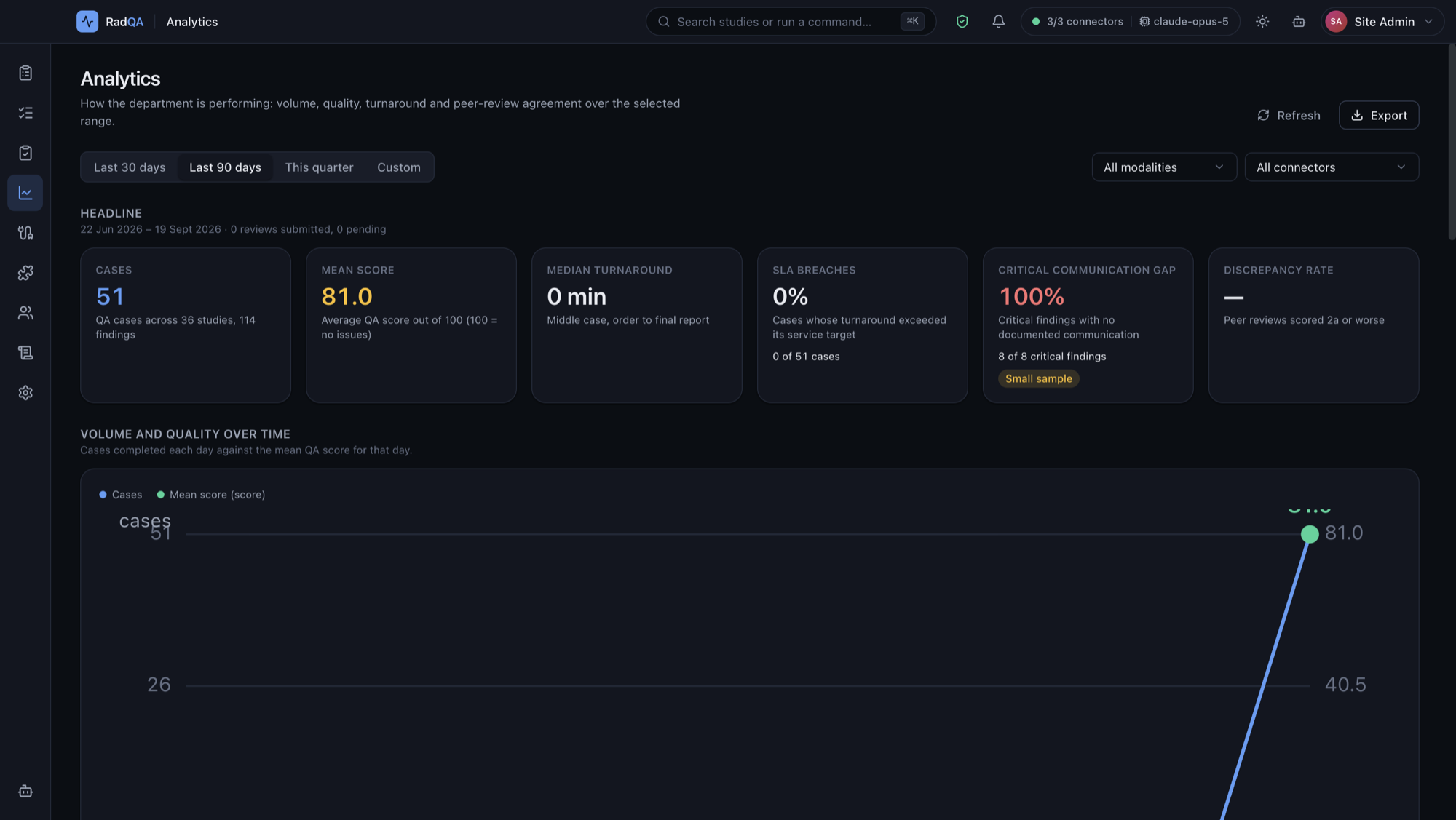
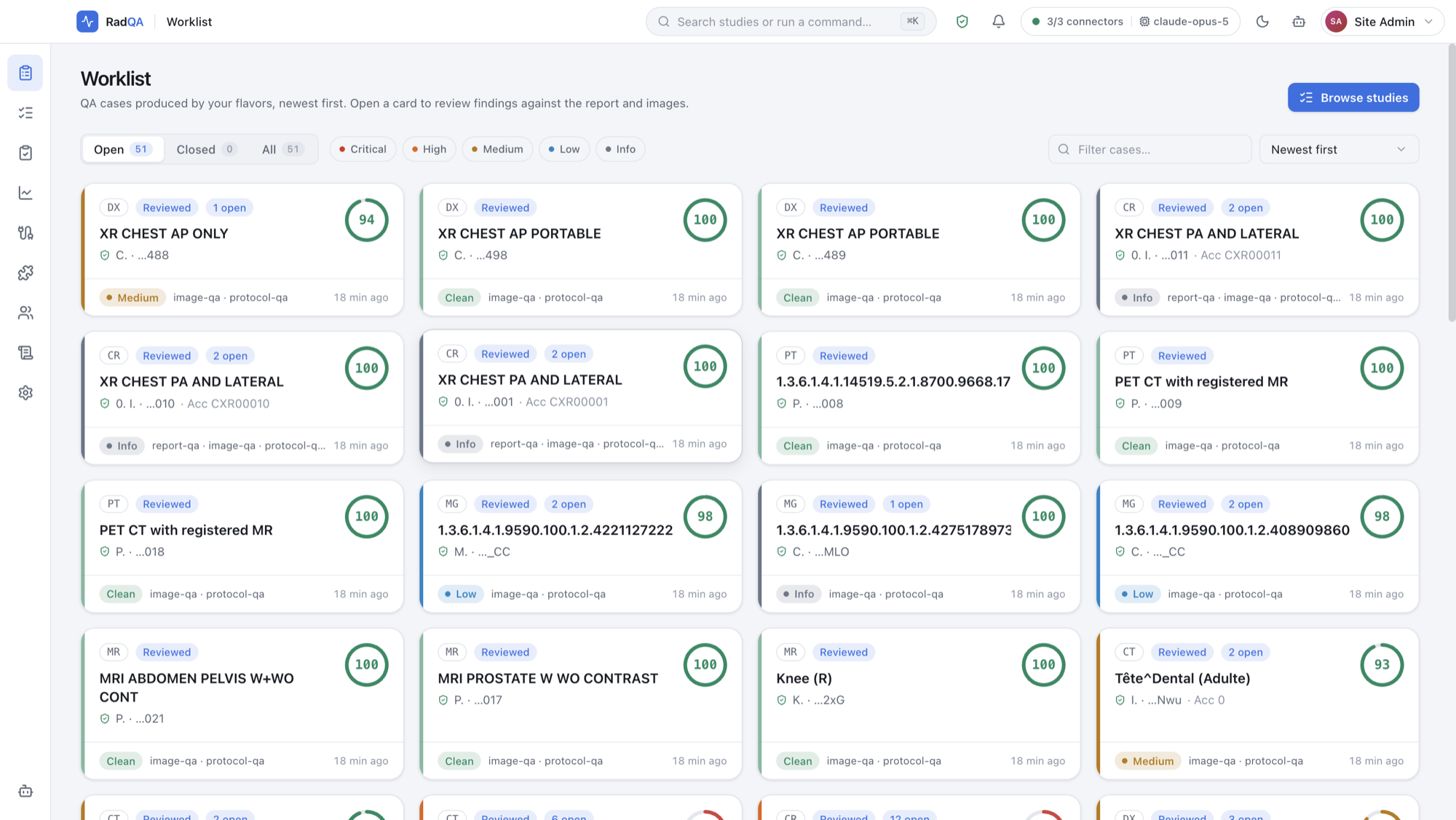
RadQA can supply the data for several of these audits: reports with a critical finding but no documented communication, incidental findings without a follow-up recommendation, laterality conflicts, template leftovers, turnaround against the routine, urgent and stat targets you set, and peer review discrepancy rates. Reports export as CSV, JSON or HTML, with notes that flag low denominators.
It does not read patient notes, so audits that ask whether a referrer acknowledged or acted on a report still need a person to check the record. RadQA is a pilot. It is a quality-assurance assistant, not a diagnostic device, and it does not replace radiologist reporting or clinical judgement.
 RadQA: AI quality assurance for radiologyWatch the demo on synthetic data, then see how it works →
Questions
What is RCR AuditLive?
The RCR's library of clinical radiology audit templates, covering over 100 topics, searchable by topic and year, many linked to QSI items.
How many cases does a radiology audit need?
It depends on the template. The RCR's alerts audit suggests at least 25 patients; its report-reading audit suggests about 50, 5 to 10 per clinical area.
Is clinical audit a legal requirement in radiology?
IR(ME)R 2017 regulation 7 requires the employer's procedures to provide for clinical audit and, since 1 October 2024, for acting on the results.
Sources
Official pages, checked November 2026. Guidance changes, so check the current version before you rely on it.
- RCR: AuditLive (Clinical radiology) audit templates
- RCR AuditLive: Assessing if radiology reports are read [QSI Ref: XR-508]
- RCR AuditLive: Assessing effectiveness of radiology alerts [QSI Ref: XR-510]
- RCR: Standards for interpretation and reporting of imaging investigations, 3rd edition (October 2025)
- legislation.gov.uk: IR(ME)R 2017 regulation 7, clinical audit
General information for healthcare managers and clinical teams, checked November 2026. It is not legal, regulatory or clinical advice; follow the current official guidance and your organisation's own policies. No patient data is used in these examples. RadQA is a quality-assurance assistant for imaging departments. It is not a diagnostic device and does not replace radiologist reporting or clinical judgement. Validate against your own systems and local governance before production use.