Guide · checked November 2026
What a radiology quality assurance programme includes
A radiology quality assurance programme covers the whole path from equipment to acted-on report: equipment quality control and assurance under IR(ME)R, image quality and dose optimisation, a reporting policy with peer review and second opinions, learning meetings, alert and fail-safe processes, turnaround monitoring and clinical audit that leads to action, usually organised around the Quality Standard for Imaging (QSI).
Equipment
IR(ME)R 2017 regulation 15 requires the employer to implement and maintain a quality assurance programme for equipment used for medical exposures, which must at least allow the dose from normal operation to be assessed and administered activity to be verified. Equipment must be tested before first use, performance-tested at regular intervals and after maintenance that could affect performance, and listed in an up-to-date inventory. The employer must set criteria of acceptable performance and the corrective action, including taking equipment out of service.
QSI 2026 item XR-603 expects a procedure that sets out which QC and QA tests are done, how often, by whom, how results reach the people using the equipment, and what happens when something is out of tolerance, with advice from a clinical scientist, medical physics expert or MR safety expert. Clinical staff should carry out and record routine QC checks, and measurement software should give reproducible results across systems.
Image quality and dose
QSI item XR-604 expects image quality and dose audits, monitoring of reject analysis, diagnostic acceptability and regular local diagnostic reference level audits, with image optimisation built into every protocol.
Reporting quality
- A reporting policy (QSI XR-706) covering roles and scope, reporting KPIs, agreed formats, a system to assure the quality, accuracy and verification of reports, amendments within set timescales, peer review, second opinions, escalation of significant findings and use of AI.
- Standard operating procedures the RCR's 2025 reporting standards ask for: turnaround times, communication of unexpected or time-critical findings, reporting priority, communication of addenda and report acknowledgement.
- Learning meetings to the RCR's 2020 REALM standards: at least six a year, 50% attendance and one case contributed per radiologist.
- Peer review and, where clinically indicated, double reporting.
Safety nets and audit
QSI item XR-707 expects a protocol for alerting referrers to unexpected findings, confirming acknowledgement, handling non-acknowledgement, escalation and out-of-hours alerts. IR(ME)R regulation 7 requires the employer's procedures to provide for clinical audit and, since 1 October 2024, for acting on the results, so the audit programme needs owners and closed loops.
Who owns what
- Medical physics: equipment testing, dose and the QA schedule.
- Radiographers: daily QC checks, image quality, reject analysis and flagging untoward findings at the time of imaging.
- Radiologists and reporting practitioners: peer review, REALMs and report standards.
- Governance lead: the audit programme, incidents and QSI evidence.
- The organisation: the fail-safe for reports not acted on.
Common misunderstandings
- Equipment QA is not only a physics job: QSI expects clinical staff to do routine QC.
- A QSI Quality Mark is evidence of a programme, not a substitute for running one.
- Audit without action no longer meets IR(ME)R regulation 7.
Where RadQA fits
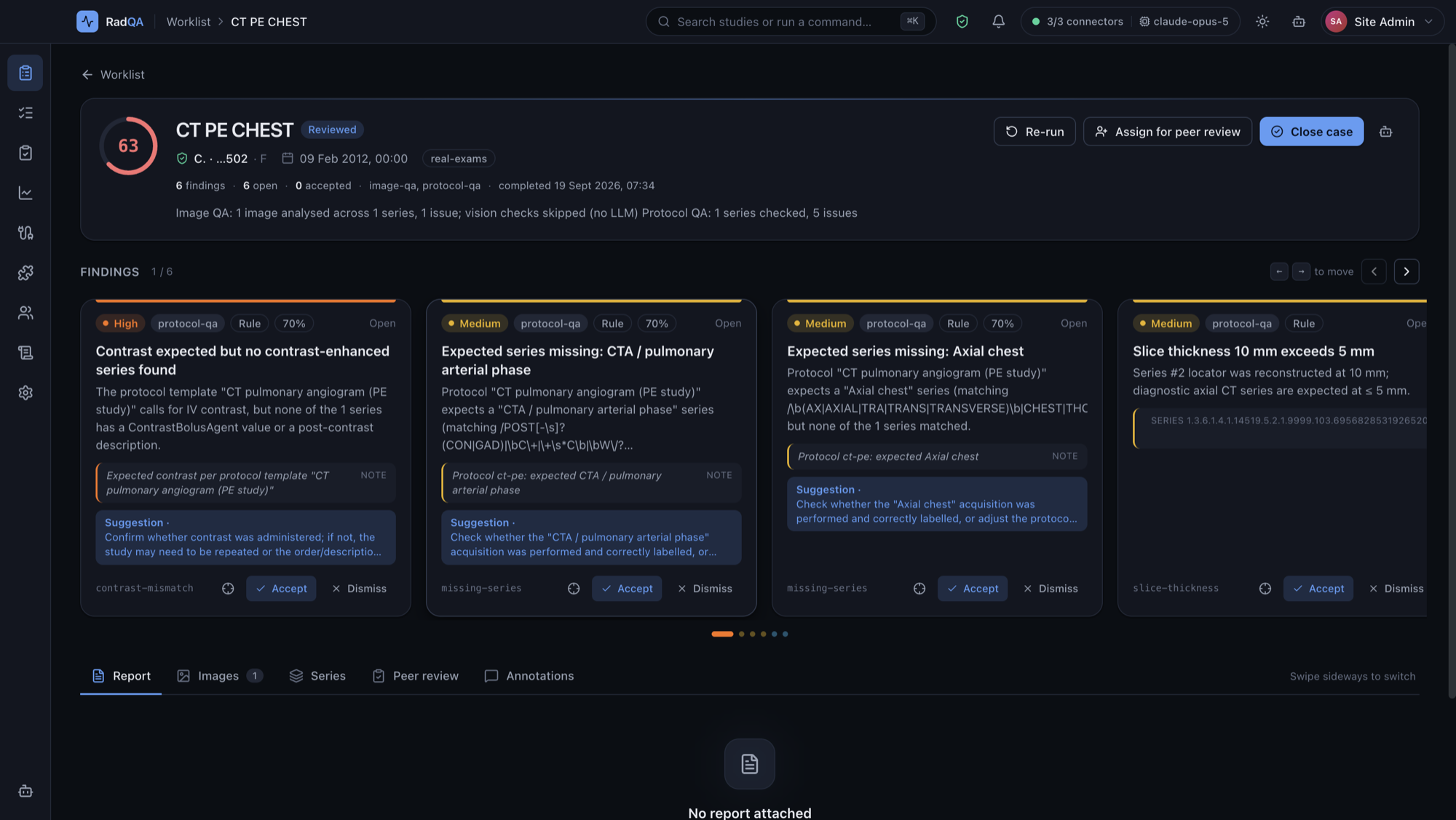
RadQA covers parts of the reporting and image side: report QA (laterality, impression against findings, critical-result communication, follow-up, template leftovers), protocol QA (missing series, contrast and slice-thickness mismatches, body part and modality checks), image QA (markers, exposure, collimation, clipped anatomy, rotation and burned-in identifiers), peer review and turnaround against your targets, with analytics and exports.
It does not do equipment performance testing, dose management or physics QA. RadQA is a pilot. It is a quality-assurance assistant, not a diagnostic device, and it does not replace radiologist reporting or clinical judgement.
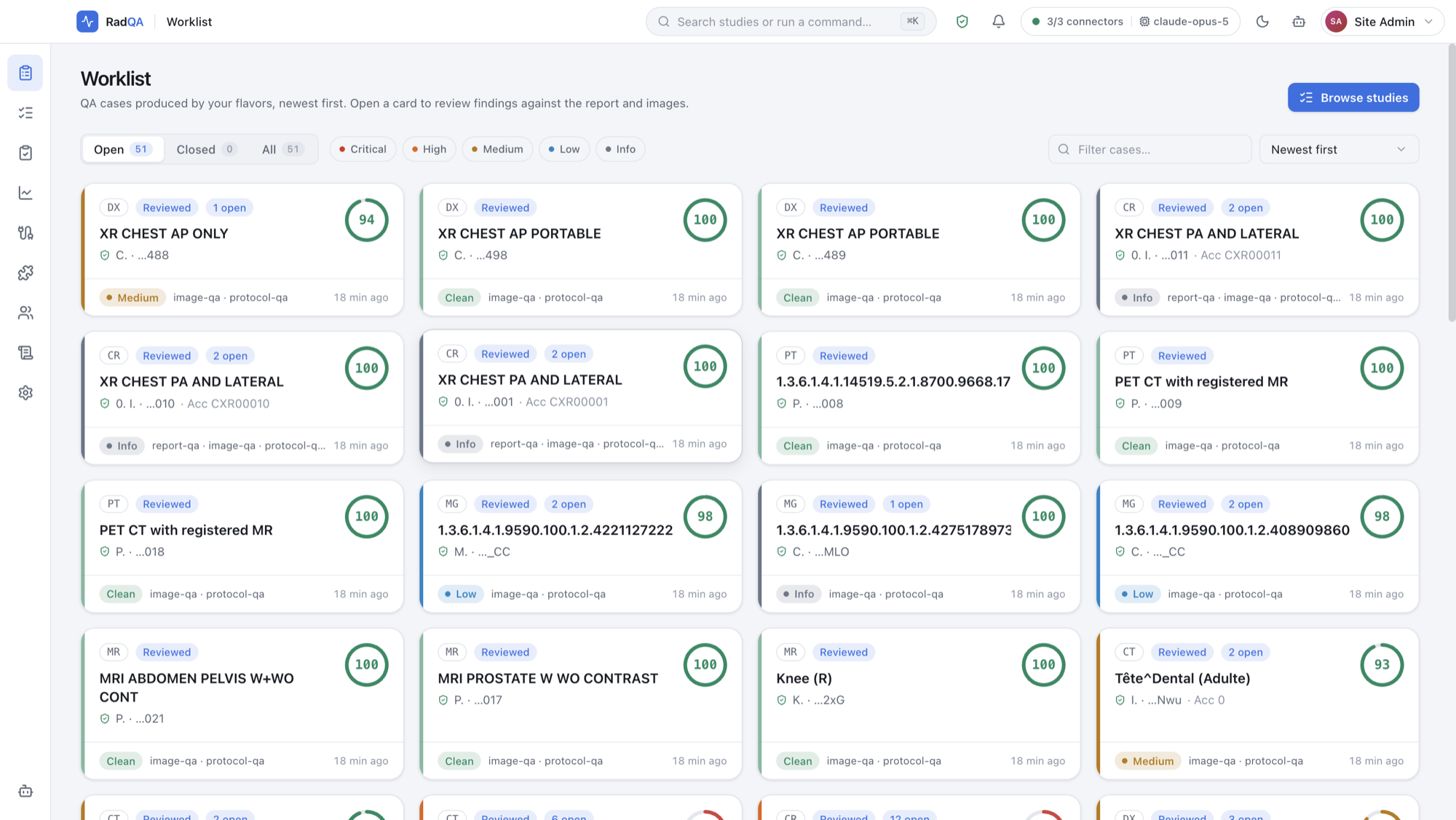 RadQA: AI quality assurance for radiologyWatch the demo on synthetic data, then see how it works →
Questions
Is equipment QA a legal requirement?
Yes, for equipment used for medical exposures. IR(ME)R 2017 regulation 15 requires a quality assurance programme and testing before first use, at regular intervals and after relevant maintenance.
What framework do UK imaging services use?
Most use the Quality Standard for Imaging, owned by the College of Radiographers and the RCR, which covers equipment, reporting, safety and learning.
Does a QA programme include report quality?
Yes. QSI XR-706 expects a reporting policy with a system to assure the quality, accuracy and verification of reports, peer review and access to a second opinion.
Sources
Official pages, checked November 2026. Guidance changes, so check the current version before you rely on it.
- legislation.gov.uk: IR(ME)R 2017 regulation 15, equipment
- CoR and RCR: Quality Standard for Imaging 2026, version 1.0
- RCR: Standards for interpretation and reporting of imaging investigations, 3rd edition (October 2025)
- RCR: Standards for radiology events and learning meetings (January 2020)
- legislation.gov.uk: IR(ME)R 2017 regulation 7, clinical audit
General information for healthcare managers and clinical teams, checked November 2026. It is not legal, regulatory or clinical advice; follow the current official guidance and your organisation's own policies. No patient data is used in these examples. RadQA is a quality-assurance assistant for imaging departments. It is not a diagnostic device and does not replace radiologist reporting or clinical judgement. Validate against your own systems and local governance before production use.