Guide · checked November 2026
Radiology discrepancy grading: categories and scales
Radiology discrepancies are usually graded on two questions: should the finding reasonably have been seen at the time (the RCR's test for whether a discrepancy is an error, and the difference between RADPEER grades 2 and 3), and is it likely to matter clinically; the RCR does not recommend scoring discrepancies in learning meetings.
The RCR's categories
The RCR's Standards for radiology events and learning meetings (2020) define the terms most UK departments use:
- Reporting discrepancy: a retrospective review, or later information about the outcome, leads to an opinion different from the original report.
- Discrepancy that is not a reporting error: the finding could only reasonably be identified with hindsight, usually with further clinical, pathological or radiological information. Most radiologists would not have reported it at the time.
- Discrepancy that is a reporting error: the reporter overlooked a finding the majority of radiologists would reasonably have been expected to see. The primary reporter and the responsible or referring clinician should be told, and the duty of candour applies if the patient came to significant harm.
- Good spot: an excellent diagnosis with a learning message, which belongs in a REALM as much as a miss does.
The RCR's sample correspondence for REALM chairs adds a fourth bucket: a clinical event, serious incident, or technical or systems error. In difficult cases the standards say it is for the trust's candour process, not the learning meeting, to decide whether a discrepancy was an error.
Categorising by cause
Appendix 2 of the RCR standards groups causes as reporter-specific or system-related. Reporter causes are cognitive (the finding was seen but attributed to the wrong cause), perceptual (the finding was missed, including satisfaction of search, where finding one abnormality ends the search early) and ambiguous wording. System causes are inadequate or misleading clinical information, poor imaging technique, and excessive workload or poor working conditions.
Recording the likely cause is often more useful than a grade, because it points to an action: a teaching session, a change to a protocol, better request information or a look at rotas.
RADPEER grades
ACR's RADPEER scale grades 1 (concur), 2 (a discrepancy not ordinarily expected to be made, an understandable miss) and 3 (a discrepancy that should be made most of the time), with a or b for unlikely or likely clinical significance. Cases are scored during routine reading, when a new study has a prior of the same area, rather than picked at random. ACR asks for 2b, 3a and 3b to go to internal review first.
ACR's page says it is not accepting applications from international facilities, so UK departments cannot join the programme, though many borrow the scale. When we checked in November 2026, the page also announced RADPEER QI, described as a modern replacement that adds peer learning tracking.
Why UK learning meetings don't score
The 2020 REALM standards say scoring or other categorisation of a suspected error is not recommended in the REALM, because it is judgemental and does not help learning, and that a scoring culture can feed a blame culture. They go further and state that scoring is no longer considered valid. Brady's 2017 review in Insights into Imaging reports that the RCR had found scoring unreliable or subjective and that RADPEER has shown low agreement between raters.
That does not stop a department using a scale for structured peer review, as long as the two processes stay separate and nobody treats a grade as a finding of fault.
Common misreadings
- Grade 2 is not "no discrepancy": it is an understandable miss.
- "Clinically significant" is a judgement about likely impact, not a record of harm.
- A REALM is not where error is decided; that belongs to the candour process.
Where RadQA fits
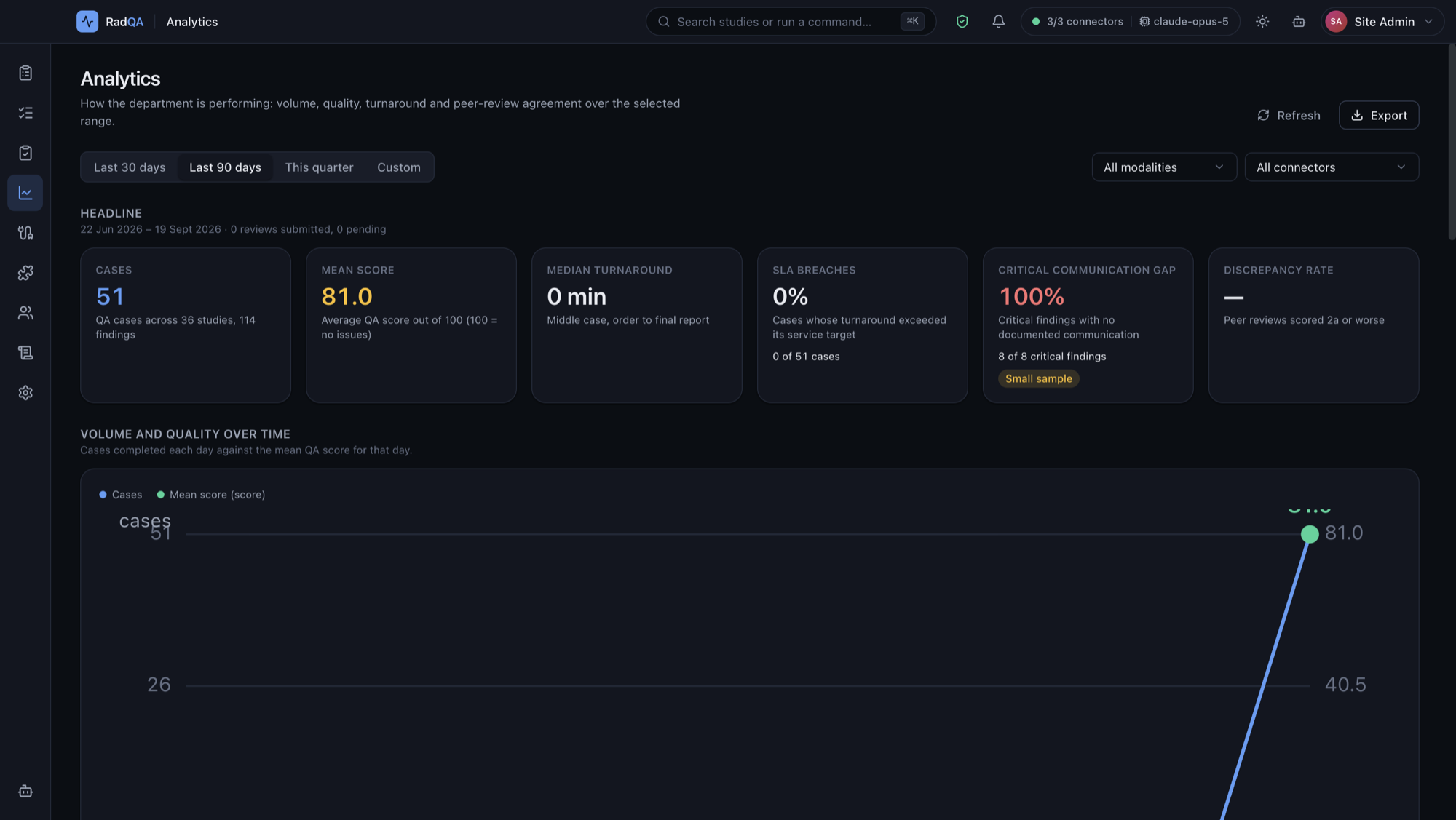
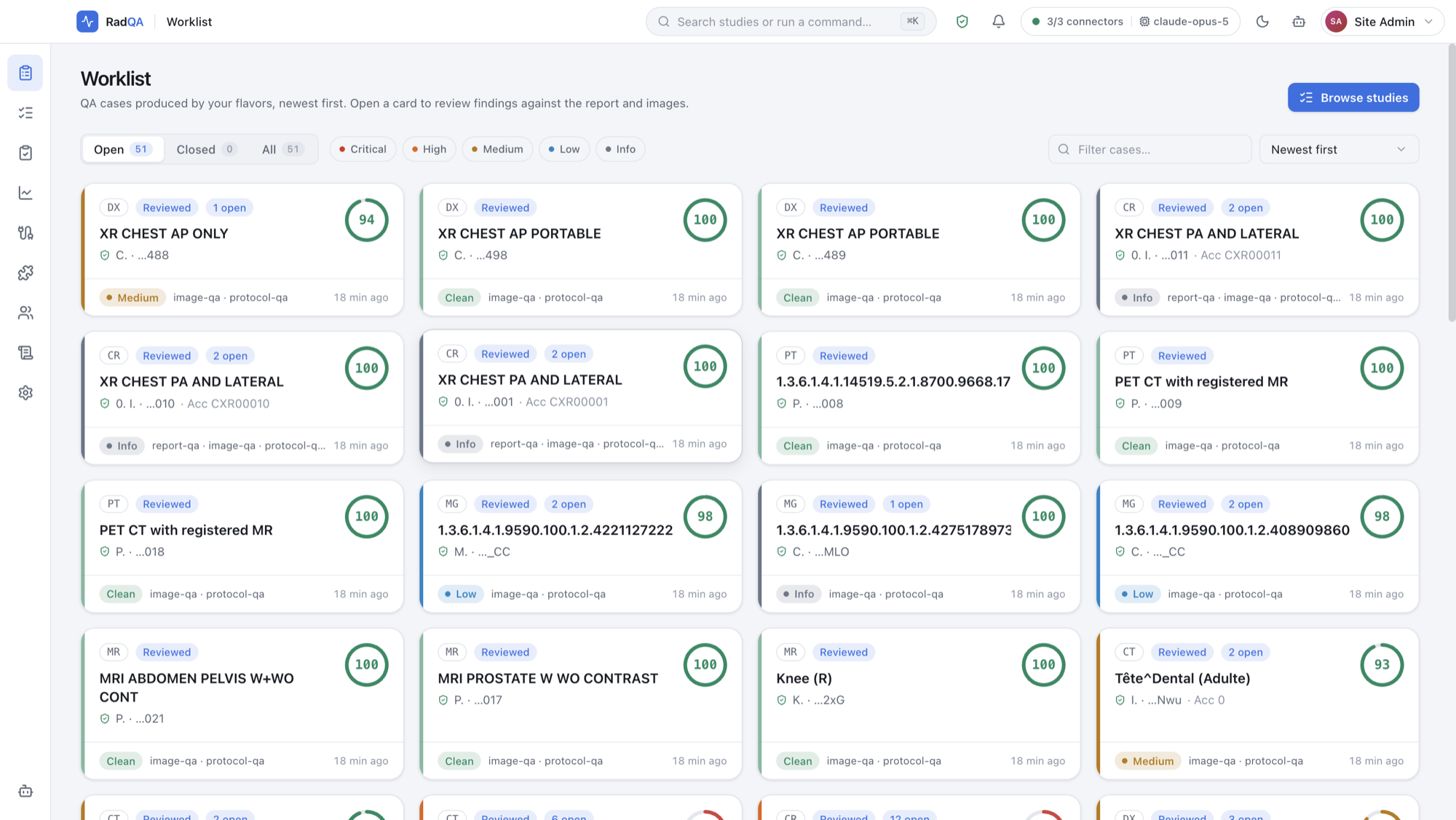
RadQA records peer review scores as 1, 2a, 2b, 3a or 3b with their descriptions, marks every score other than 1 as a discrepancy and the b scores as clinically significant, and lets a lead sign off a score as agreed, revised or rejected. Where a model compares a report with the most recent comparable prior, it suggests a score for a person to accept or change. Analytics show the score distribution over a period.
RadQA does not decide whether a discrepancy was an error or whether the duty of candour applies. RadQA is a pilot. It is a quality-assurance assistant, not a diagnostic device, and it does not replace radiologist reporting or clinical judgement.
 RadQA: AI quality assurance for radiologyWatch the demo on synthetic data, then see how it works →
Questions
What are the categories in radiology peer review?
In RADPEER: concur, an understandable miss, and a miss that should be made most of the time, each with a significance modifier. The RCR separates discrepancies that are errors from those that are not.
Is every discrepancy an error?
No. The RCR's 2020 standards say some discrepancies could only be identified with hindsight, so they are not reporting errors.
Who decides whether a discrepancy was an error?
In difficult cases the RCR says it is for the trust's candour process, not the learning meeting.
Sources
Official pages, checked November 2026. Guidance changes, so check the current version before you rely on it.
General information for healthcare managers and clinical teams, checked November 2026. It is not legal, regulatory or clinical advice; follow the current official guidance and your organisation's own policies. No patient data is used in these examples. RadQA is a quality-assurance assistant for imaging departments. It is not a diagnostic device and does not replace radiologist reporting or clinical judgement. Validate against your own systems and local governance before production use.