
Guide · checked November 2026
Types of errors in radiology: perceptual, cognitive and system
Radiology errors are usually split into perceptual errors, where an abnormality is visible but not seen, and cognitive errors, where it is seen but misinterpreted; perceptual errors are the larger group, 60–80% in the figures cited by Brady's 2017 review, and system factors such as poor clinical information, poor technique and heavy workload feed both.
The main types
- Perceptual (observational): the finding is identifiable but was missed.
- Satisfaction of search: finding one abnormality ends the search early, so other related or unrelated abnormalities are missed.
- Cognitive (interpretive): the finding was seen but attributed to the wrong cause, sometimes through lack of knowledge.
- Communication: ambiguous wording or summary, or a correct report that never reaches the person who needs it.
- System-related: inadequate, misleading or incorrect clinical information, poor imaging technique, and excessive workload or poor working conditions.
This grouping follows Appendix 2 of the RCR's Standards for radiology events and learning meetings (2020). The RCR adds that, in one study it cites, the clinical diagnosis changed in 50% of cases after the clinician and radiologist talked, which shows how much the request information matters.
How often each type happens
Brady's review (Insights into Imaging, 2017) cites Bruno and colleagues: perceptual errors make up 60–80% of radiology errors and cognitive errors 20–40%.
It also summarises Kim and Mansfield's 2014 analysis of 1,269 errors collected over eight years at one US Army medical centre. Under-reading was the commonest category at 42%, then satisfaction of search at 22%, faulty reasoning at 9%, an abnormality outside the area of interest at 7%, satisfaction of report (carrying forward a previous report's conclusion) at 6%, failure to consult prior imaging at 5%, and inaccurate or incomplete clinical history at 2%. These come from one centre's error log, so read them as a pattern rather than a benchmark for your service.
Biases behind the errors
Brady describes the cognitive biases that sit behind many misses: anchoring on a first impression, framing by the request, availability of a recent memorable case, confirmation bias, premature closure, and outcome or hindsight bias when cases are reviewed later. Knowing the outcome makes a missed finding look more obvious than it was at the time, which matters when you review colleagues' work.
What helps
- Proofreading: the RCR's 2025 reporting standards say careful proofreading can prevent missed negatives, word substitution and wrong-side attribution.
- Looking at everything: the same standards say all acquired images, including scout images and non-target areas, should be reviewed.
- Priors and clinical details: failure to consult prior imaging and poor history both appear in the error categories above.
- Structure: Brady notes structured reporting improves content and clarity, with the risk that a reader focused on one section misses an unexpected finding.
- Learning without blame: discussing cases in learning meetings, rather than scoring individuals, is the RCR's approach.
Brady also reports that, in the studies he cites, changing working conditions or teaching de-biasing had little measurable effect on error rates, so no single fix should be expected to remove errors.
What an error does not mean
- Not negligence by default: Brady's review states that error or discrepancy in reporting does not equate to negligence.
- Not always the reporter's fault: missing clinical details, poor technique and workload are system causes.
- Not proof of carelessness: perceptual misses happen to experienced radiologists too.
Where RadQA fits
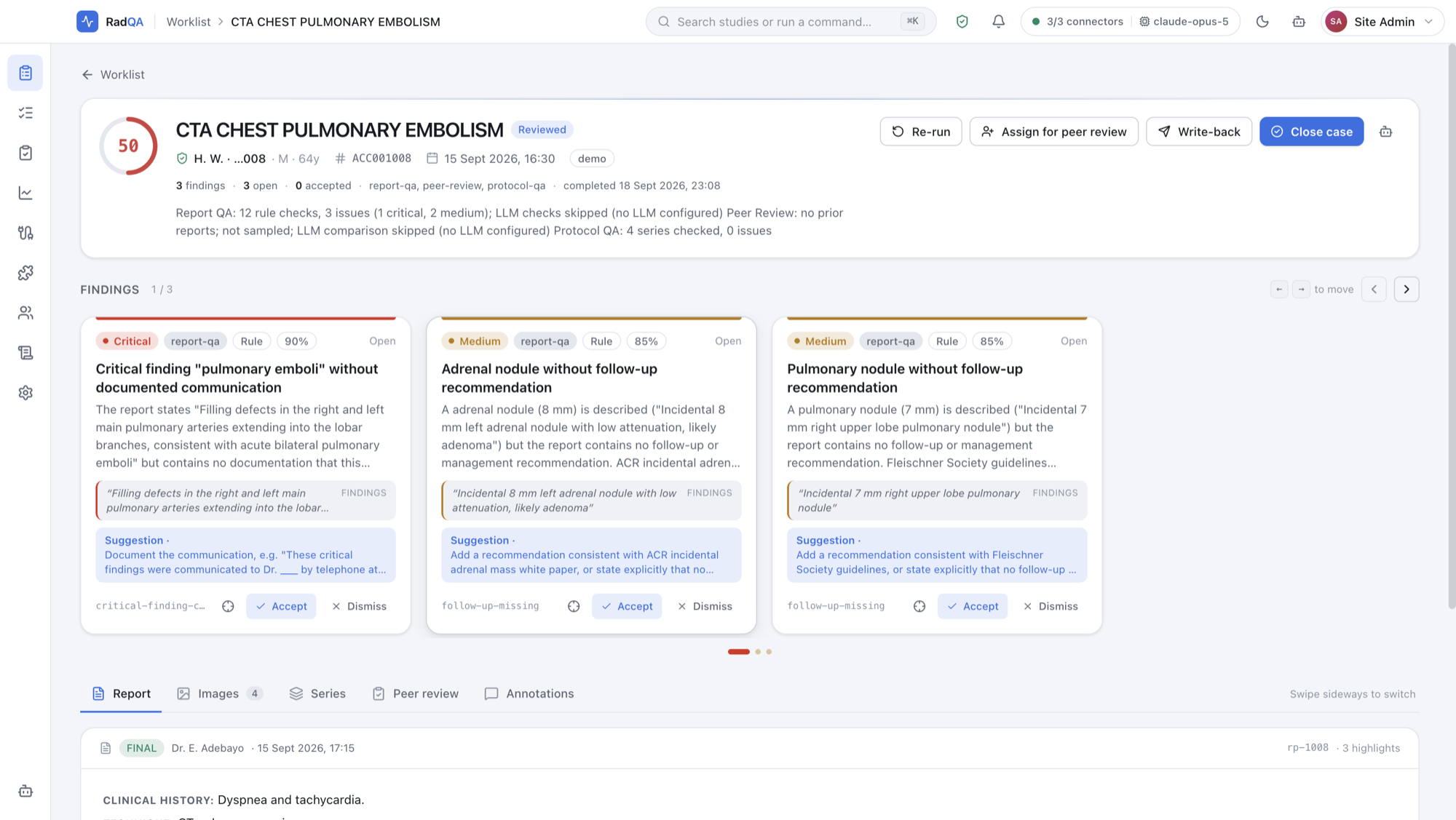
RadQA does not look for missed pathology on images, so it cannot catch perceptual misses. What its report QA can flag are errors visible in the text: laterality conflicts, an impression that contradicts the findings, measurements that differ between findings and impression, a missing comparison when priors exist, template leftovers and critical findings with no documented communication. Image QA flags technique problems such as missing markers, exposure, collimation and rotation.
Analytics count findings by check, so a department can see which kinds of problem recur. RadQA is a pilot. It is a quality-assurance assistant, not a diagnostic device, and it does not replace radiologist reporting or clinical judgement.
 RadQA: AI quality assurance for radiologyWatch the demo on synthetic data, then see how it works →
Questions
What is the most common type of radiology error?
Perceptual error, where a visible abnormality is missed. Brady's review cites perceptual errors as 60–80% of the total.
What is satisfaction of search?
Finding one abnormality ends the search early, so other related or unrelated abnormalities are missed.
Is a radiology error negligence?
Not automatically. Brady's review states that error or discrepancy in reporting does not equate to negligence; whether a specific case was negligent is a legal question.
Sources
Official pages, checked November 2026. Guidance changes, so check the current version before you rely on it.
General information for healthcare managers and clinical teams, checked November 2026. It is not legal, regulatory or clinical advice; follow the current official guidance and your organisation's own policies. No patient data is used in these examples. RadQA is a quality-assurance assistant for imaging departments. It is not a diagnostic device and does not replace radiologist reporting or clinical judgement. Validate against your own systems and local governance before production use.