
Guide · checked November 2026
How often are radiology reports wrong? Discrepancy rates
Yes, a radiology report can be wrong: day-to-day error rates of around 3–5% of studies are widely cited, retrospective reviews find discrepancies averaging about 30%, and the RCR says the published range runs from 3% to 30% because methods, case mix and definitions of error differ so much.
The headline figures
- Berlin (2007), cited in Brady's 2017 review: a day-to-day, real-time error rate of 3–5%, and a retrospective error rate averaging 30%.
- The RCR's 2020 REALM standards: reporting discrepancies are common, between 3% and 30% of reports in published literature.
- Bruno and colleagues (2015), cited by Brady: applying a rate of about 4% to roughly a billion studies a year gives around 40 million errors.
Why the range is so wide
The RCR says there are no objective benchmarks for acceptable levels of discrepancy. It points to markedly varying methods and widely differing definitions of error in the literature, and says case mix, selection bias, modality and variation between and within observers make standard-setting very difficult.
Knowing the outcome changes the answer. Brady cites Harvey and colleagues (1993): prior mammograms of women later diagnosed with breast cancer showed the cancer in 41% on blinded reinterpretation, but in 75% when reviewers knew the outcome. A study that reviews only cases with a known later diagnosis will always find more "misses" than a random sample.
Examples from the literature
Brady's review tabulates studies such as these. They come from second reads and research settings, often enriched with abnormal cases, so they are not error rates for a typical service:
- Robinson and colleagues (1999): major disagreement between two observers in 5–9% of emergency department radiographs, with an error incidence of 3–6% per observer.
- Quekel and colleagues (1999): a 19% missed-diagnosis rate for lung cancer on chest radiographs.
- Siewert and colleagues (2008): discordant interpretations in 31–37% of oncology CT studies.
- Briggs and colleagues: 13% major and 21% minor discrepancies on second reads of neuroradiology CT and MRI.
- Abujudeh and colleagues (2010): major discrepancy rates of 26% between observers and 32% for the same observer rereading CT.
Using a local rate
Always show the denominator, the period and how cases were selected. Random sampling estimates the rate across routine work; targeted review of known problems inflates it; review by people who know the outcome inflates it further. Compare your service with itself over time rather than with another department's figure, and look at the causes and clinical significance behind the number.
If you are a patient worried about a report, the RCR says referrers must be able to ask for a second opinion on the same examination without it being treated as a question of competence, and that the second opinion should be recorded. Speak to the clinician who referred you.
What the numbers do not mean
- Thirty per cent is not the share of reports that are wrong in everyday practice; it comes from retrospective review.
- A low local rate can mean few reviews or lenient reviewers, not perfect reporting.
- A discrepancy is not always an error, and Brady's review states that error does not equate to negligence.
Where RadQA fits
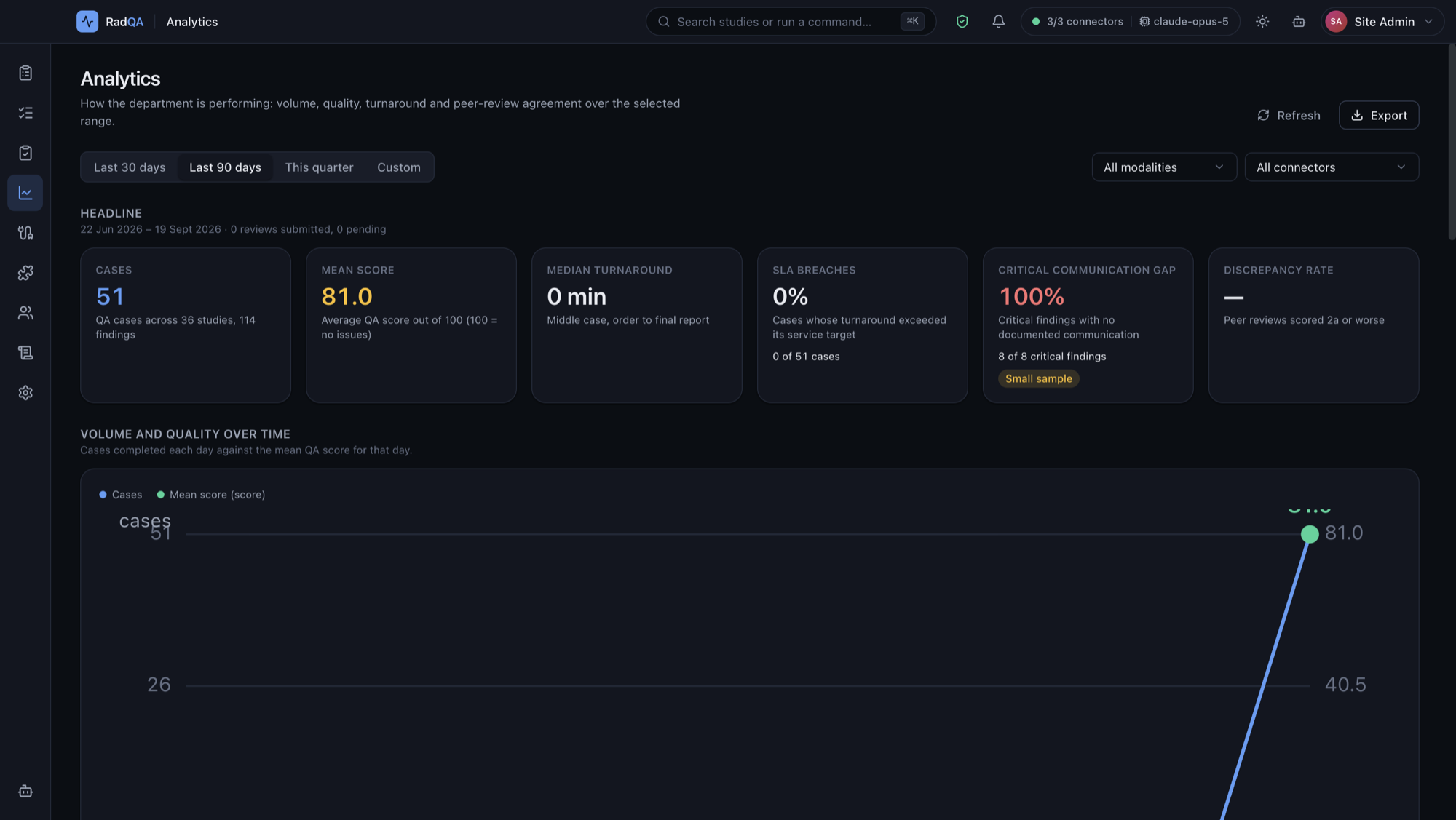
RadQA's analytics show the peer review discrepancy rate over any range, by modality, alongside reviews submitted and pending and the spread of scores. Exports carry notes that flag when a figure stands on very few cases. Because sampling is deterministic, you can state exactly how cases were chosen.
RadQA cannot tell you your true error rate: it measures what was reviewed. RadQA is a pilot. It is a quality-assurance assistant, not a diagnostic device, and it does not replace radiologist reporting or clinical judgement.
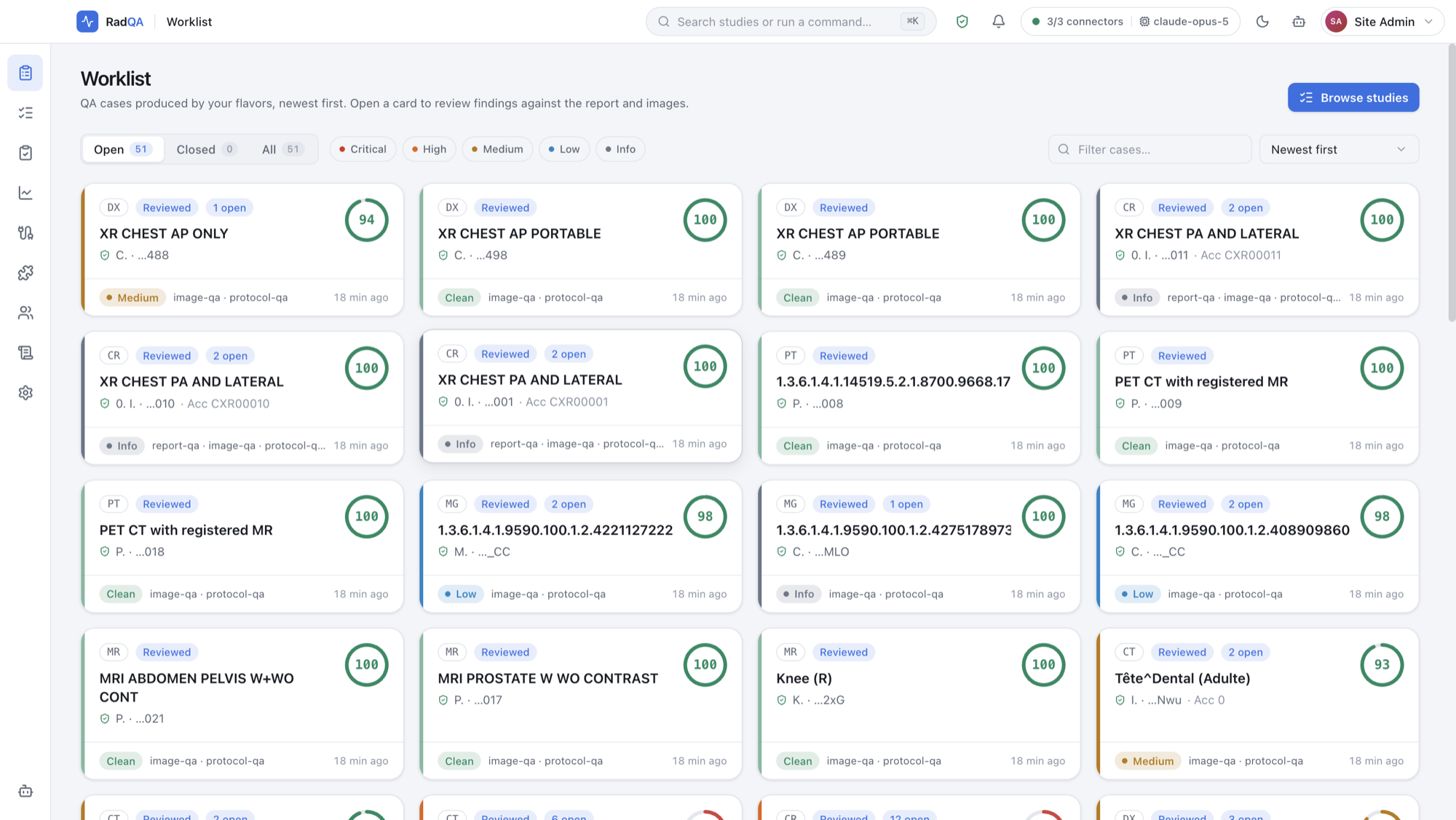 RadQA: AI quality assurance for radiologyWatch the demo on synthetic data, then see how it works →
Questions
Can a radiologist's report be wrong?
Yes. Day-to-day error rates of around 3–5% are widely cited, and the RCR says discrepancies are common.
What is an acceptable radiology discrepancy rate?
There is no agreed figure. The RCR's 2020 standards say there are no objective benchmarks for acceptable levels.
Why do studies report such different rates?
They use different methods, case mixes and definitions of error, and reviewers who know the outcome find more misses.
Sources
Official pages, checked November 2026. Guidance changes, so check the current version before you rely on it.
General information for healthcare managers and clinical teams, checked November 2026. It is not legal, regulatory or clinical advice; follow the current official guidance and your organisation's own policies. No patient data is used in these examples. RadQA is a quality-assurance assistant for imaging departments. It is not a diagnostic device and does not replace radiologist reporting or clinical judgement. Validate against your own systems and local governance before production use.