Guide · checked November 2026
Radiology peer review template: the fields to include
A radiology peer review template records which study was reviewed and why it was chosen, who reviewed it and whether they were blinded to the original reporter, the reviewer's rating, whether any discrepancy is likely to matter clinically, a short rationale, and what happened next: feedback to the reporter, an addendum, a learning meeting or escalation.
The fields to include
- Case: accession or RIS number, modality, examination and report date. Keep patient identifiers out of anything that leaves the review record.
- Why it was chosen: random sample, targeted review (a modality or a new reporter), a prior met while reporting a new study, or a referral from a colleague or MDT.
- Reviewer: who reviewed it, confirmation they were not the original reporter, and whether the original reporter's name was hidden.
- Rating: agreement or the type of discrepancy, on a scale the department has agreed in advance.
- Clinical significance: whether the discrepancy is likely to change management, recorded as its own field so it is never left implied.
- Rationale: what was seen and why the reviewer rated it that way, written for learning rather than judgement.
- Actions: feedback to the primary reporter, an addendum, submission to a radiology events and learning meeting (REALM), or referral to the incident or duty of candour process.
- Sign-off: whether a lead or committee agreed, revised or rejected the rating, and when.
- Dates: when the case was assigned, when it is due and when the review was submitted, so the backlog can be measured.
Choosing a rating scale
ACR's RADPEER scale is the one most people know: 1 means the reviewer concurs, 2 is a discrepancy not ordinarily expected to be made (an understandable miss), and 3 is a discrepancy that should be made most of the time. Each discrepancy is then marked as unlikely or likely to be clinically significant, giving 2a, 2b, 3a and 3b. ACR asks for 2b, 3a and 3b to go to internal review first, for example by a chair, medical director or QA committee.
The RCR's 2020 REALM standards take a different line for learning meetings. They do not recommend scoring or otherwise categorising a suspected error in a REALM, because it is a judgemental exercise and a scoring culture can feed a blame culture. Brady's 2017 review also notes that scoring has proved unreliable, with low agreement between raters. Many UK departments therefore keep a rating inside a structured peer review programme and leave the learning meeting score-free.
A simple first question works whatever scale you use. The RCR's sample correspondence for REALM chairs sorts a submitted case as a discrepancy, a good spot, a good educational case, or a clinical event, serious incident or technical or systems error. Adding that field means good catches are recorded as well as misses.
Blinding and hindsight
The REALM standards ask that cases be presented anonymously, with the patient, primary reporter and notifier not identified. The RCR documents cited here set no rule on blinding the reviewer in routine peer review, but hiding the original reporter until the rating is submitted reduces bias in both directions.
Hindsight is the other trap. The RCR points out that the original reporter often had more time and more local clinical information than a later reviewer, and Brady's review warns that knowing the outcome makes a missed finding look more obvious than it was. Give the reviewer the clinical details and priors the original reporter had, and say on the form if the reviewer knew the outcome.
Feedback that people will read
The RCR's sample correspondence suggests a short, non-judgemental addendum that points to the later scan and report, and a factual note to the primary reporter giving both report dates. If the primary reporter cannot be contacted in the trust, for example a locum or teleradiologist, the sample suggests passing the case to the clinical governance lead for radiology. The Quality Standard for Imaging 2026 (XR-706) expects the reporting policy to cover peer review, so the template and the way feedback is given belong in that policy.
What a completed form does not mean
- A rating is one reviewer's opinion, which a lead can revise.
- A blank significance box is not the same as "not significant": make the field mandatory.
- A discrepancy is not automatically an error; the RCR says some findings are only identifiable with hindsight.
Where RadQA fits
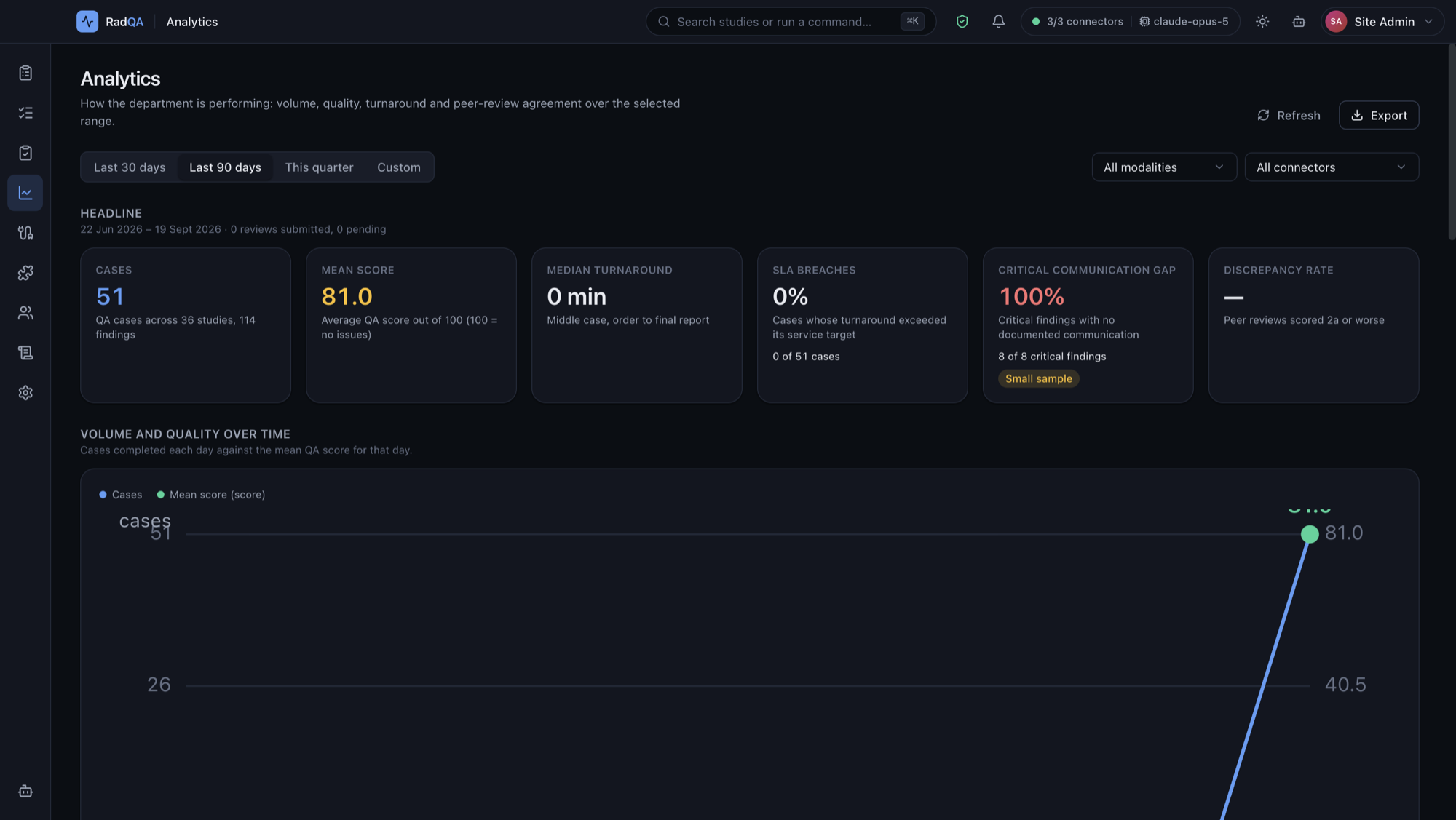
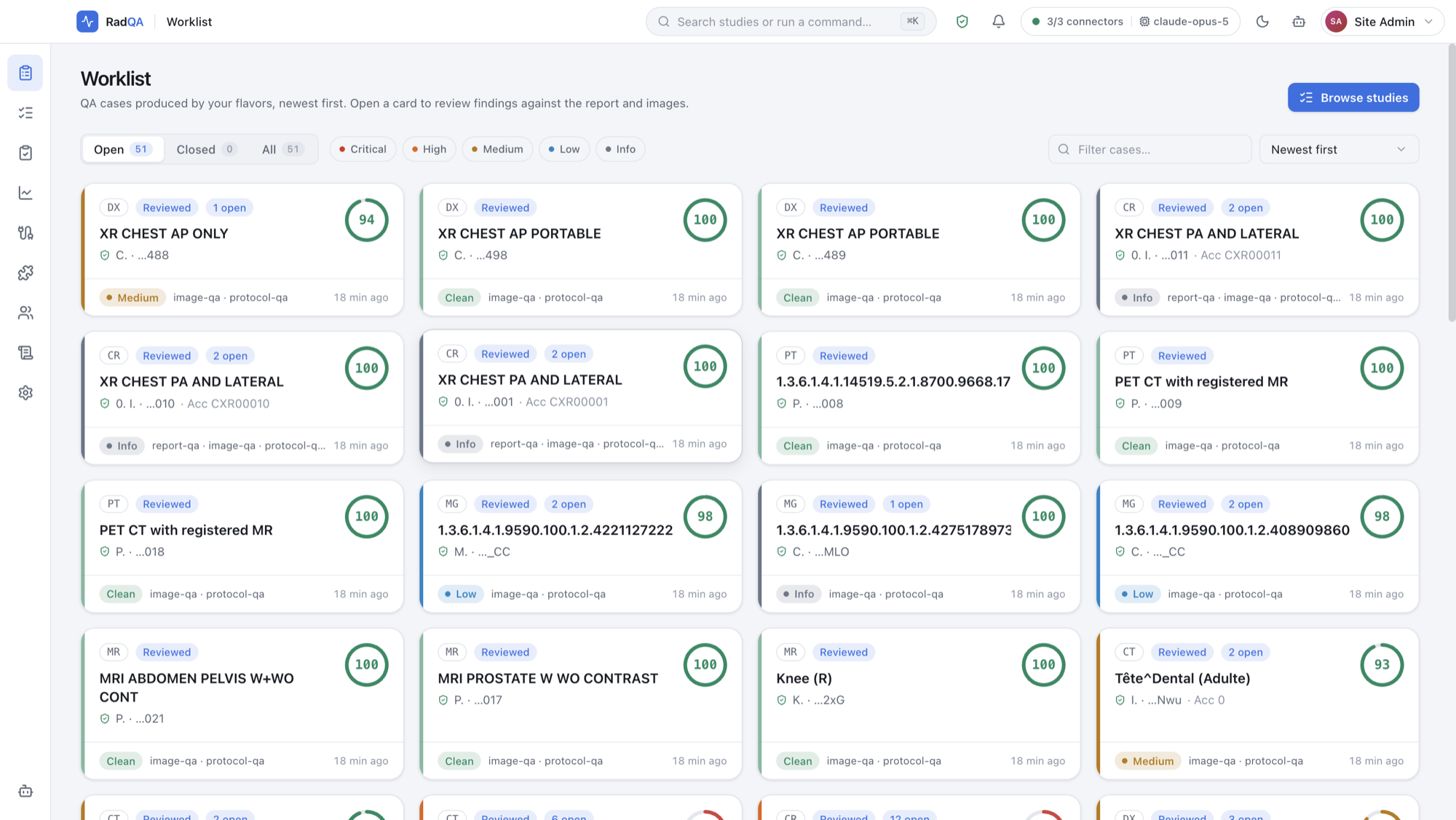
RadQA's peer review record already holds these fields: why the case reached review (sampled, assigned or escalated), the reviewer, whether the review is blinded, a RADPEER-style score with its plain-language description, a clinical significance flag, a free-text comment, a due date, and a committee sign-off recorded as agreed, revised or rejected. Blinded reviews hide the original radiologist and the prior findings until the reviewer has submitted their own score.
Cases are sampled deterministically at a percentage you set (5% by default), and a reviewer is never assigned their own case. RadQA is a pilot. It is a quality-assurance assistant, not a diagnostic device, and it does not replace radiologist reporting or clinical judgement.
 RadQA: AI quality assurance for radiologyWatch the demo on synthetic data, then see how it works →
Questions
What fields should a radiology peer review form have?
At minimum the study, why it was chosen, the reviewer, whether they were blinded, the rating, clinical significance, a rationale, the action taken and any sign-off.
Should the template use RADPEER scores?
It can. RADPEER gives a familiar 1 to 3 scale with a significance modifier, but the RCR does not recommend scoring in REALMs, so keep any scale inside the peer review programme.
Should the reviewer know who wrote the report?
The RCR documents cited here do not require blinding in routine peer review, but many departments hide the original reporter until the rating is in to reduce bias.
Sources
Official pages, checked November 2026. Guidance changes, so check the current version before you rely on it.
General information for healthcare managers and clinical teams, checked November 2026. It is not legal, regulatory or clinical advice; follow the current official guidance and your organisation's own policies. No patient data is used in these examples. RadQA is a quality-assurance assistant for imaging departments. It is not a diagnostic device and does not replace radiologist reporting or clinical judgement. Validate against your own systems and local governance before production use.