Guide · checked November 2026
Radiology peer review software: what to look for
Good radiology peer review software chooses cases fairly and reproducibly, never gives reporters their own work, can hide the original reporter, records a rating with clinical significance and a rationale, routes significant discrepancies to a lead, feeds learning meetings without names, and reports rates with their denominators, using the PACS and RIS you already have.
Choosing cases
- Reproducible sampling: you should be able to show why a case was chosen, and the same rule should choose the same case again.
- Targeted review: a modality, a new reporter, a new protocol or a period of concern.
- Review during routine reading: ACR's RADPEER model scores a prior when a new study of the same area is read.
- Ad hoc referrals from colleagues and MDT meetings, which the RCR lists among the routes into learning meetings.
- Exclusion of the original reporter from reviewing their own case.
Reviewing
- Blinding: the option to hide the original reporter until the rating is in.
- Context: the same request details and prior imaging the original reporter had, to limit hindsight bias.
- A rating scale you can configure, such as RADPEER's 1 to 3 with a significance modifier, or simple categories.
- Free-text rationale and a due date, so reviews do not drift.
After the review
- Escalation of significant ratings: ACR asks for RADPEER 2b, 3a and 3b to go to internal review first.
- Lead or committee sign-off that can agree, revise or reject a rating.
- Feedback to the primary reporter, which the RCR's 2020 REALM standards make the notifier's job.
- Anonymised export of cases for the REALM chair.
- A clear hand-off to incident and duty of candour processes, which the RCR keeps separate from learning meetings.
Reporting and governance
Look for discrepancy rates shown with the number of reviews and the period, the spread of ratings, time to review and trends by modality. Individual-level figures should be limited to the people who need them for appraisal and learning. The Quality Standard for Imaging 2026 (XR-706) expects a reporting policy with a system to assure the quality, accuracy and verification of reports, and peer review of reporting, so the software's outputs should map onto that policy.
Be realistic about what ratings can show. Brady's 2017 review reports that RADPEER has shown low agreement between raters, so a single reviewer's score is weak evidence about an individual, and patterns across many reviews matter more.
Integration and security
- Connection to PACS for images and priors, and to RIS or the EPR for reports and request details.
- Mapping of reporters' identities across systems, so own-case exclusion and blinding work.
- Role-based access and an audit trail of who saw and changed what.
- A data flow you can describe in a data protection impact assessment, including any external model provider.
What software will not fix
- Software does not make scoring reliable; the scale and the culture matter more.
- More reviews are not more learning if nobody reads the feedback.
- A peer review tool is not a REALM, which has its own RCR standards.
Where RadQA fits
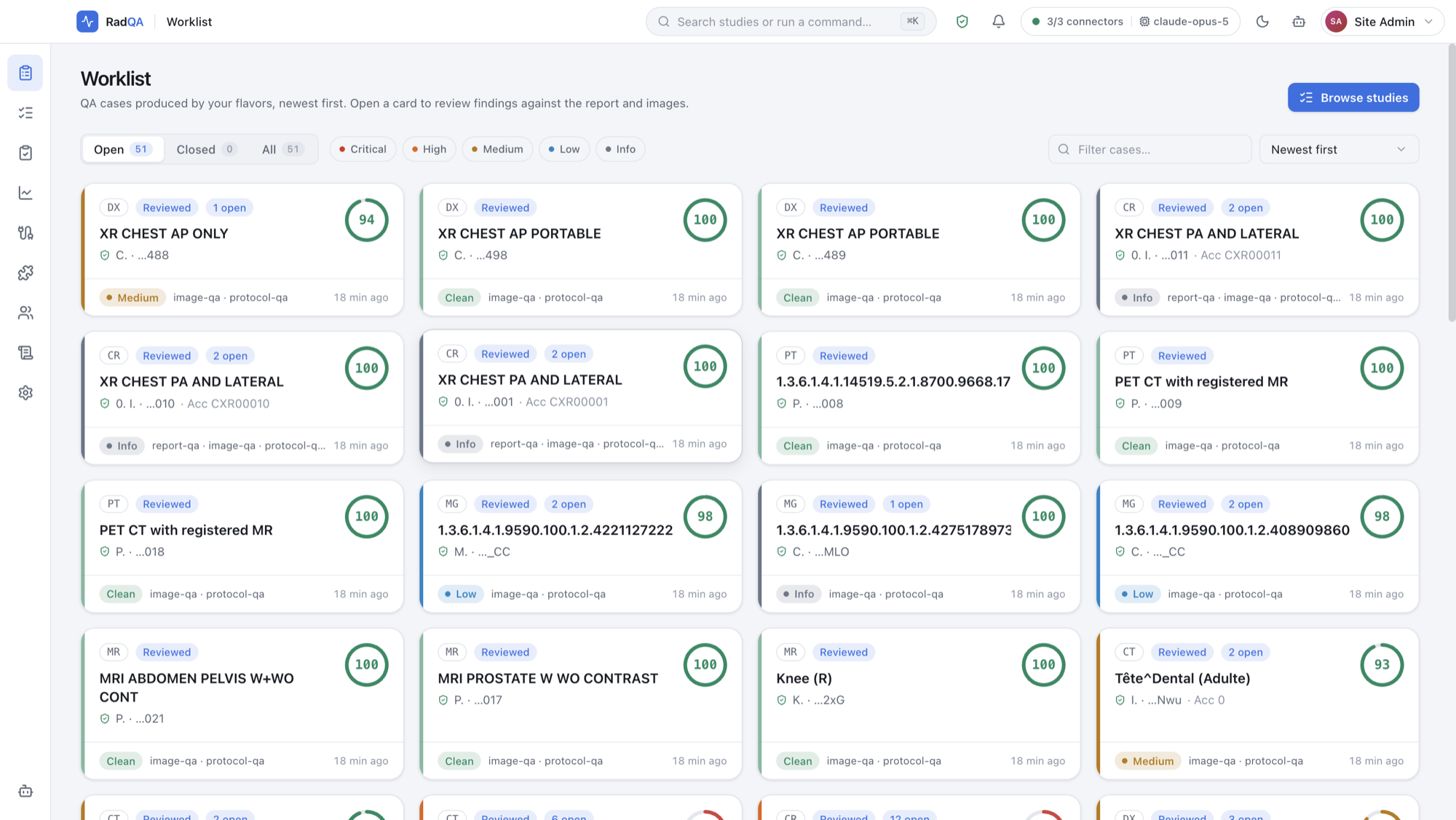
RadQA's peer review module samples studies with a stable hash at a percentage you set (5% by default), can always sample named radiologists, and assigns reviewers in turn while excluding the reporting radiologist. Blinded reviews hide the original radiologist and the prior findings until the reviewer submits. Reviews carry a RADPEER-style score, comment, significance flag and due date, and a lead signs them off as agreed, revised or rejected. RadQA can also flag possible discrepancies against the most recent comparable prior for a person to review.
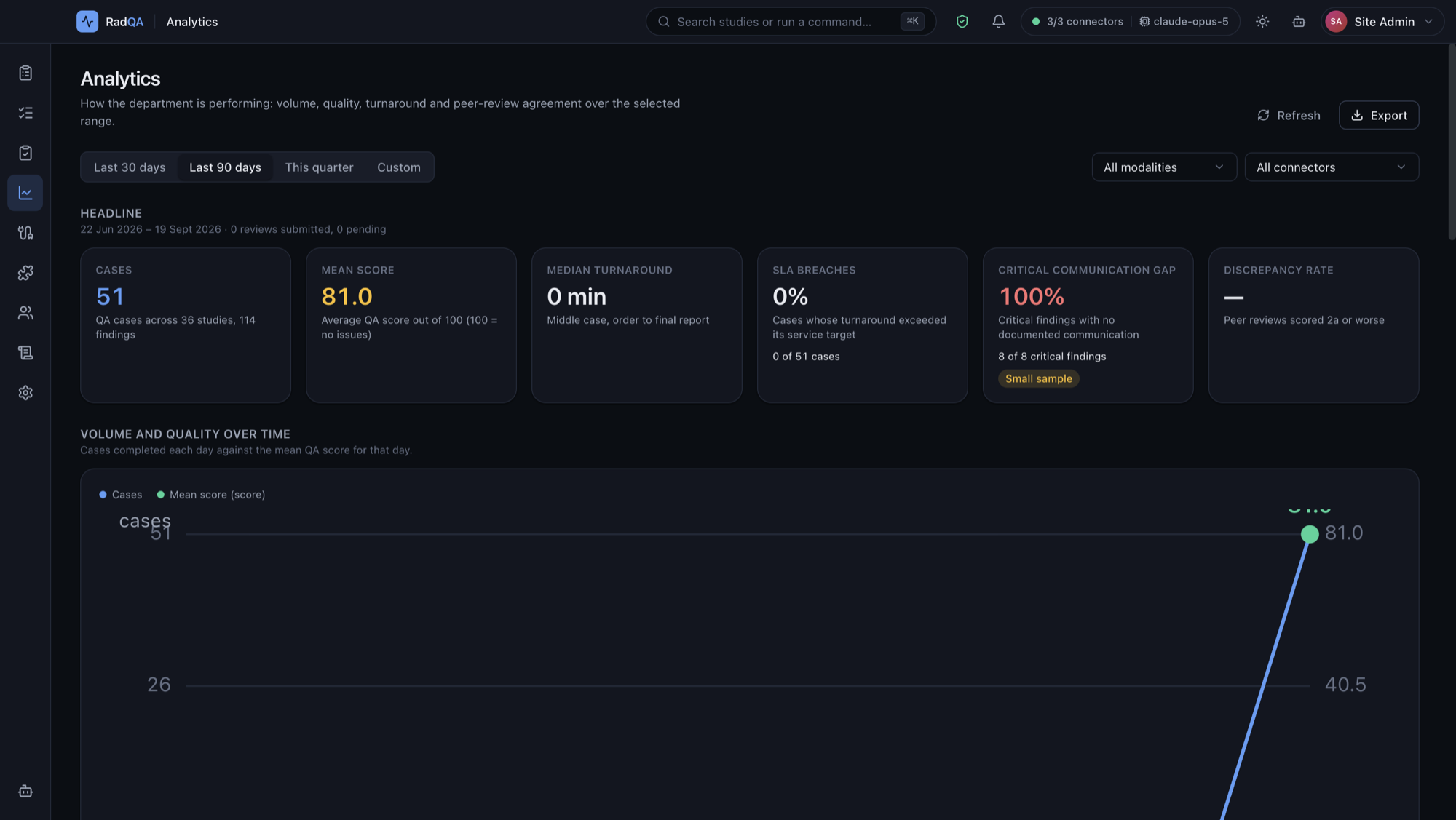
Analytics show discrepancy rates and score distributions, with per-radiologist figures only for users allowed to see them, and export to CSV, JSON or HTML. RadQA connects to DICOMweb PACS, HL7 v2 RIS feeds, FHIR R4 servers or a local folder, and logs every decision. It does not run REALM meetings. RadQA is a pilot. It is a quality-assurance assistant, not a diagnostic device, and it does not replace radiologist reporting or clinical judgement.
 RadQA: AI quality assurance for radiologyWatch the demo on synthetic data, then see how it works →
Questions
Can peer review software choose cases automatically?
Yes. Look for sampling that is reproducible and auditable, so you can show why each case was chosen.
Should peer review software score cases?
It can support a scale such as RADPEER's, but the RCR does not recommend scoring in learning meetings, so keep scoring and REALM discussion separate.
What integrations matter most?
Access to the images, the report, prior studies and the request details the original reporter saw, usually through PACS and RIS.
Sources
Official pages, checked November 2026. Guidance changes, so check the current version before you rely on it.
General information for healthcare managers and clinical teams, checked November 2026. It is not legal, regulatory or clinical advice; follow the current official guidance and your organisation's own policies. No patient data is used in these examples. RadQA is a quality-assurance assistant for imaging departments. It is not a diagnostic device and does not replace radiologist reporting or clinical judgement. Validate against your own systems and local governance before production use.