Guide · checked November 2026
Buying radiology AI software: what to check
To evaluate radiology AI software, start from the problem and the pathway, check the product's regulated intended purpose and UKCA marking, read the evidence for a population like yours, confirm accuracy locally (ideally in shadow mode), complete the clinical safety and data protection work, and agree how performance will be monitored after go-live; the RCR's 2024 AI deployment fundamentals sets these out as minimum standards.
Start with the problem, not the product
- Form a working group of pathway and imaging leads and technical experts, and ask everyone to declare conflicts of interest.
- Define the problem and where in the pathway the tool would act, for example prioritising the reporting worklist or supporting a diagnosis.
- Agree who will and will not use it, and what they need to know about its limits.
- Record how the pathway performs now, so you can compare after deployment and spot side effects such as more CT or MRI.
- Ask whether AI is the right answer at all, and whether an in-house team could build or support it.
Regulation and evidence
The RCR's AI deployment fundamentals (November 2024) says to request documentation on intended purpose, functionality, limitations, risks and training data, and calls UKCA marking through MHRA assessment a basic requirement for NHS use. It says a valid CE mark was equally acceptable until 30 June 2028 at the time of writing; check MHRA's current position before you rely on that date. It also stresses that a UKCA mark or other approval does not mean the tool is clinically effective or cost-effective in your setting, and that the tool's regulated intended purpose must match your problem.
MHRA's guidance says software, including AI, is regulated as a medical device in many cases, explains how manufacturers write an intended use statement, and asks for problems with a device to be reported through the Yellow Card scheme. In England, DCB0129 covers the supplier's clinical safety work and DCB0160 the deploying organisation's; the RCR notes DCB0129 forms part of the Digital Technology Assessment Criteria (DTAC).
On evidence, look at NICE evaluations and published studies, check that the tool was tested in a population like yours, ask how diverse the training and test data were, and agree in advance what sensitivity, specificity and clinical utility you will accept. The RCR expects performance in real clinical use to differ from testing.
Validate it locally
- A diagnostic accuracy study with patients who have and do not have the condition, including how accurate your reporters are without the tool.
- A specificity sample that reflects your referral population, since mimics drive false positives.
- Shadow mode as the standard first step: the tool runs without its output being used clinically, so you can measure local performance.
- Independent validation where you can get it; the RCR notes there is currently little independent evaluation of chest X-ray AI in a UK population.
- A hazard log that covers false positives and false negatives, with mitigations recorded in your DCB0160 work.
Contract, data and monitoring
- A data protection impact assessment built on a map of where data flows, and a data processing agreement with the vendor.
- Technical minimums the RCR lists, such as MHRA compliance, use of the NHS number or a DICOM identifier, GDPR compliance and Cyber Essentials or ISO 27001.
- Integration with PACS, RIS and your network, and training that teaches users to make their own interpretation first.
- A plan for product updates, which may need re-testing, a named contact for reporting errors to the vendor, and an agreement to stop using the tool on an immediate significant safety concern.
- Clear labelling in reports: the RCR's 2025 reporting standards say AI-generated content should be identified and approved by a named human author.
What a buyer should not assume
- A UKCA mark is not proof the tool works for your patients.
- A vendor's published accuracy is not your accuracy.
- Go-live is not the end: updates and drift need monitoring.
Where RadQA fits
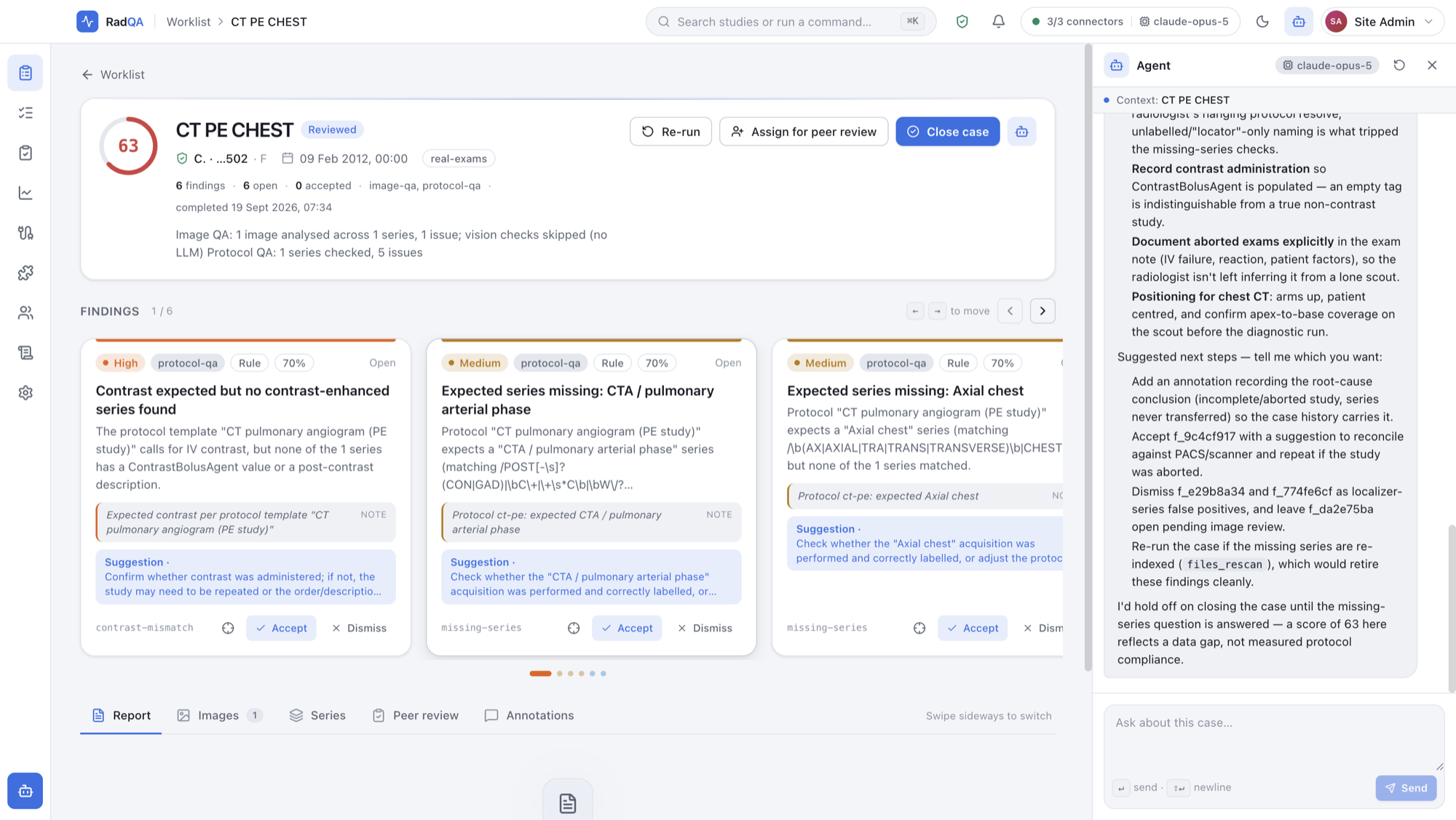
Most of this checklist is written for AI that detects pathology or triages studies. RadQA does neither: it checks the quality of reports, protocols and images that have already been produced, and every finding is advisory, shows its evidence and says whether a rule or a model produced it. RadQA has no UKCA or CE marking; its intended-use document argues that a QA tool which does not inform an individual patient's diagnosis sits outside device rules, and says a regulatory professional should review that before live use.
Many of the questions still apply. Model-backed checks send only the text or image needed for that check to the model provider your department configures, with prompts de-identified by default and a strict mode that keeps report text on the machine. Every decision and write-back is logged, and write-backs need explicit approval. RadQA is a pilot. It is a quality-assurance assistant, not a diagnostic device, and it does not replace radiologist reporting or clinical judgement.
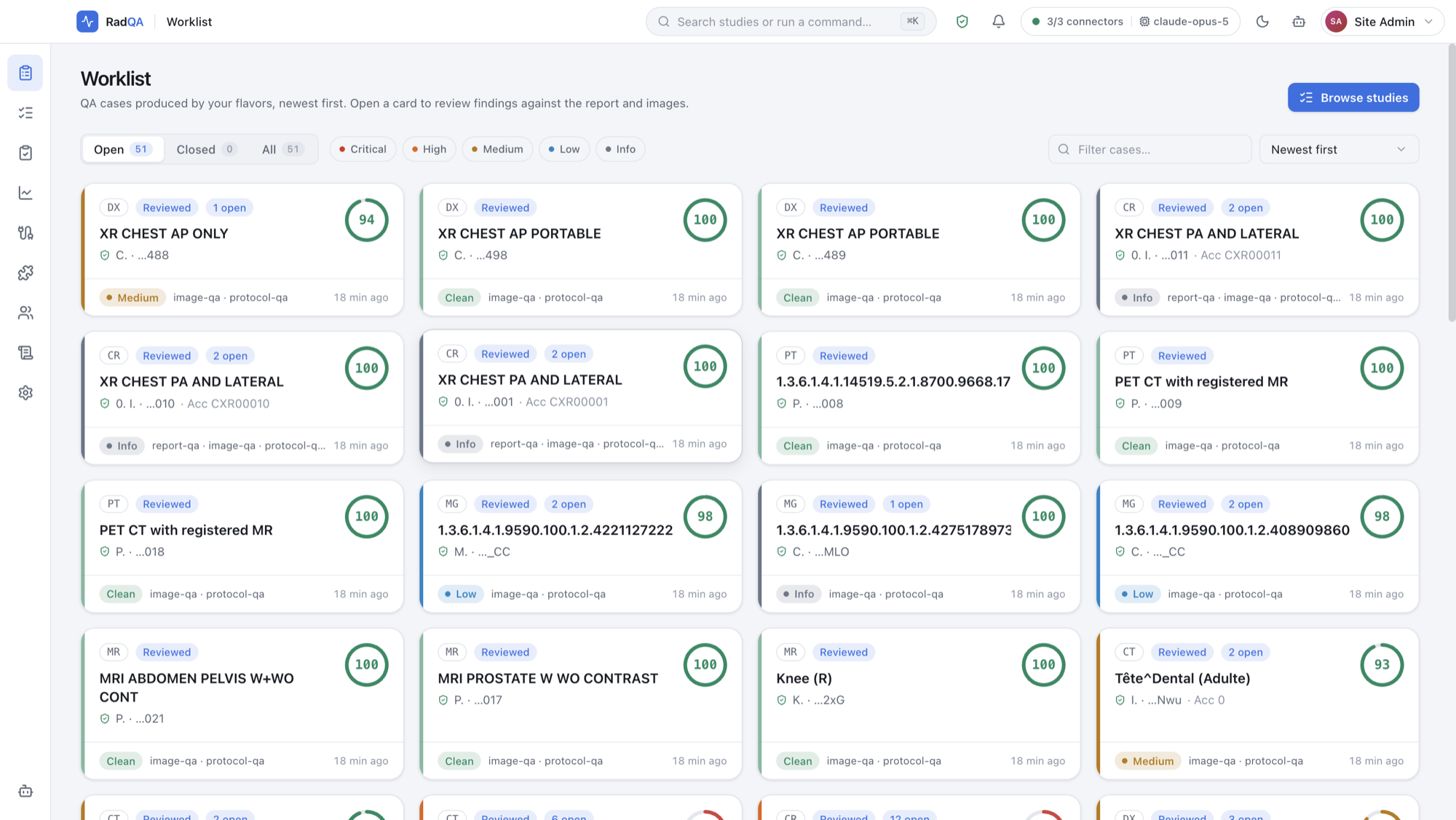 RadQA: AI quality assurance for radiologyWatch the demo on synthetic data, then see how it works →
Questions
Does radiology AI need a UKCA mark?
The RCR's 2024 guidance calls UKCA marking a basic requirement for NHS use, with a valid CE mark accepted until 30 June 2028 at the time of writing. Check MHRA for the current position.
What is shadow mode?
Running the AI on cases without its output being used clinically, to measure local performance before go-live. The RCR recommends it as a standard deployment model.
Who is responsible for an AI-assisted report?
The RCR's 2025 reporting standards say AI-derived contributions must be reviewed, verified and approved by a named human author, who is responsible for the final report.
Sources
Official pages, checked November 2026. Guidance changes, so check the current version before you rely on it.
General information for healthcare managers and clinical teams, checked November 2026. It is not legal, regulatory or clinical advice; follow the current official guidance and your organisation's own policies. No patient data is used in these examples. RadQA is a quality-assurance assistant for imaging departments. It is not a diagnostic device and does not replace radiologist reporting or clinical judgement. Validate against your own systems and local governance before production use.