Guide · checked November 2026
Quality assurance for outsourced and teleradiology reporting
Outsourced and teleradiology reports should meet the same standard, under the same governance, as reports made in your own department: the RCR's teleradiology standards ask for teleradiology to sit inside an integrated service with a documented quality assurance framework, and QSI 2026 expects outsourcing policies and contracts to be documented, monitored and reviewed, with transparent audit.
The RCR's four standards
Standards for the provision of teleradiology within the United Kingdom (second edition, December 2016) sets four standards:
- Data transfer: rapid, secure transfer and review of images, without inappropriate delay.
- Reporting: the same standard wherever and by whomever the study is reported, with access to the same clinical information, previous images and reports and laboratory data as in the base hospital, on equipment of at least the same standard.
- Communication: the person who interprets the study issues the report, is clearly identified, and the report is integrated into the base hospital's RIS, PACS and EPR in good time. For especially urgent results the teleradiologist should be able to speak to the referrer, and verbal opinions must be documented.
- Quality assurance: teleradiology is part of an integrated service under the same governance framework, with every radiologist working within a documented QA framework in line with RCR guidance.
The document adds that teleradiologists reporting British patients should be on the GMC Clinical Radiology Specialist Register and indemnified to the same standard as the base organisation, that the provider must address issues the trust identifies under a comprehensive contract, that the contract must say who keeps responsibility for the patient, and that patients should be told their imaging is reported elsewhere.
What QSI 2026 adds
- Outsourcing policies that say what to outsource and when, with thresholds and suitable providers.
- Defined training and competencies for outsourced reporters, and a specified scope for specialist work.
- Transparent and comparable audit processes from outsourcing companies.
- Contracts that clarify responsibility for registration and regulatory compliance, and SLAs that are monitored.
- Documented processes for critical findings, including a way to track reports.
- A process for complaints and incidents, and KPIs that reflect local case mix and are transparent to both parties.
These suggestions sit under QSI item XR-307, outsourcing and insourcing.
Remote reporting in the 2025 standards
The RCR's 2025 reporting standards say remote reporting, including from home, should not compromise quality compared with in-hospital reporting, and that network arrangements must meet the same technical and governance standards. Remote reporters need clinical records and imaging history. Teleradiologists working for private providers may not know local pathways, and organisations using them must put safeguards in place, such as liaison with clinical teams or MDT participation, plus business continuity plans for technical failures.
A practical QA loop
- Sample outsourced reports into the same peer review as in-house work, blinded to the provider where you can.
- Agree a named route for discrepancy feedback. The RCR's sample REALM correspondence suggests passing cases to the clinical governance lead when a teleradiologist cannot be contacted directly.
- Compare turnaround, discrepancy rates and critical-finding handling by provider over time.
- Bring the figures to contract review meetings with the provider's own audit results.
Context matters for the business case. An RCR press release in May 2026, based on preliminary 2025 census data, said the NHS spent £241m in 2025 on private teleradiology companies and that 90% of radiology leaders were concerned outsourced reports needed double-checking. Those are preliminary survey findings, not a standard.
Common misunderstandings
- Outsourcing the reporting does not outsource accountability; the contract must say who keeps responsibility.
- The provider's own QA does not replace yours; the RCR wants one governance framework.
- Re-reading every outsourced report is not a QA programme; sampling with feedback is.
Where RadQA fits
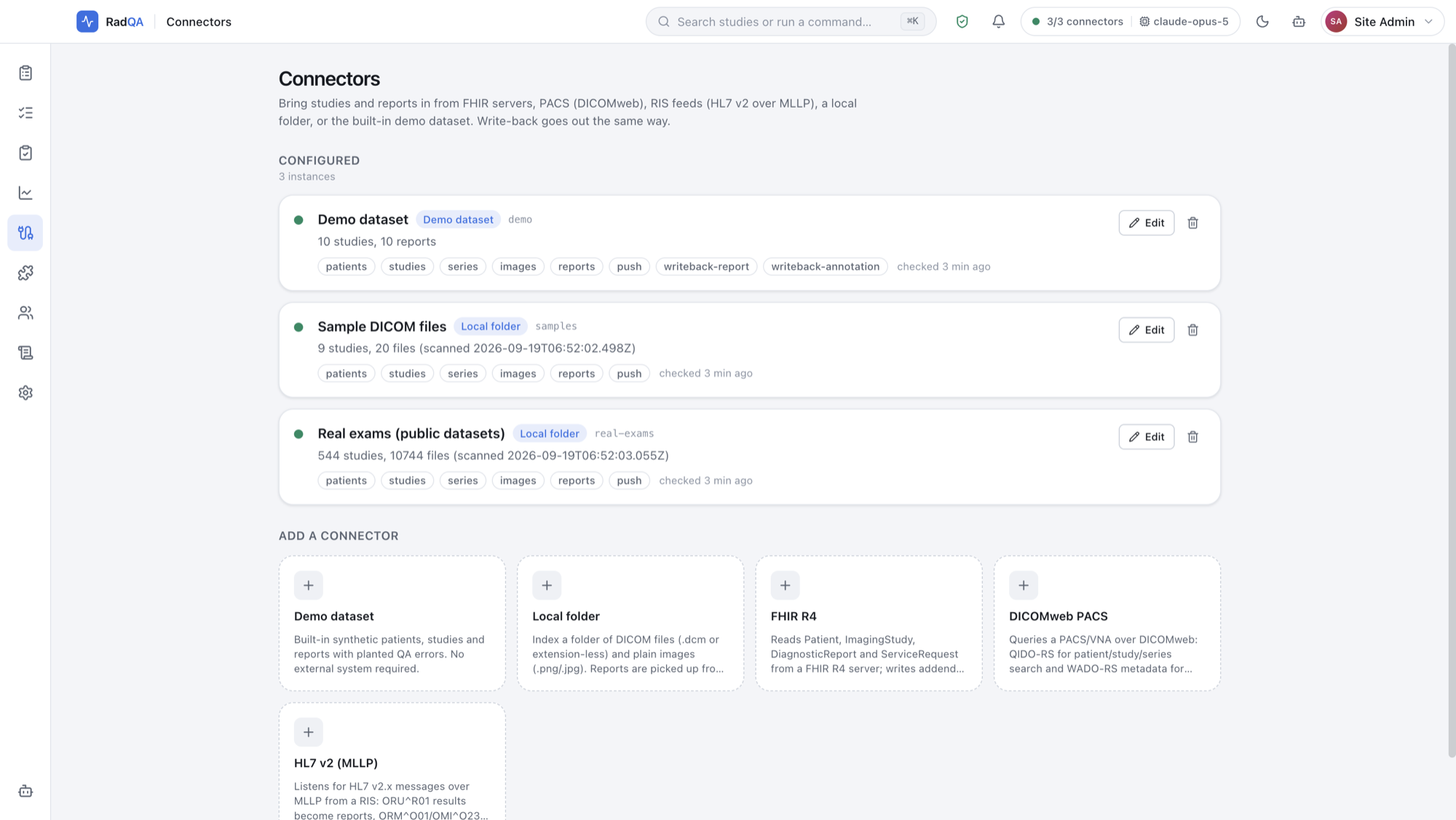
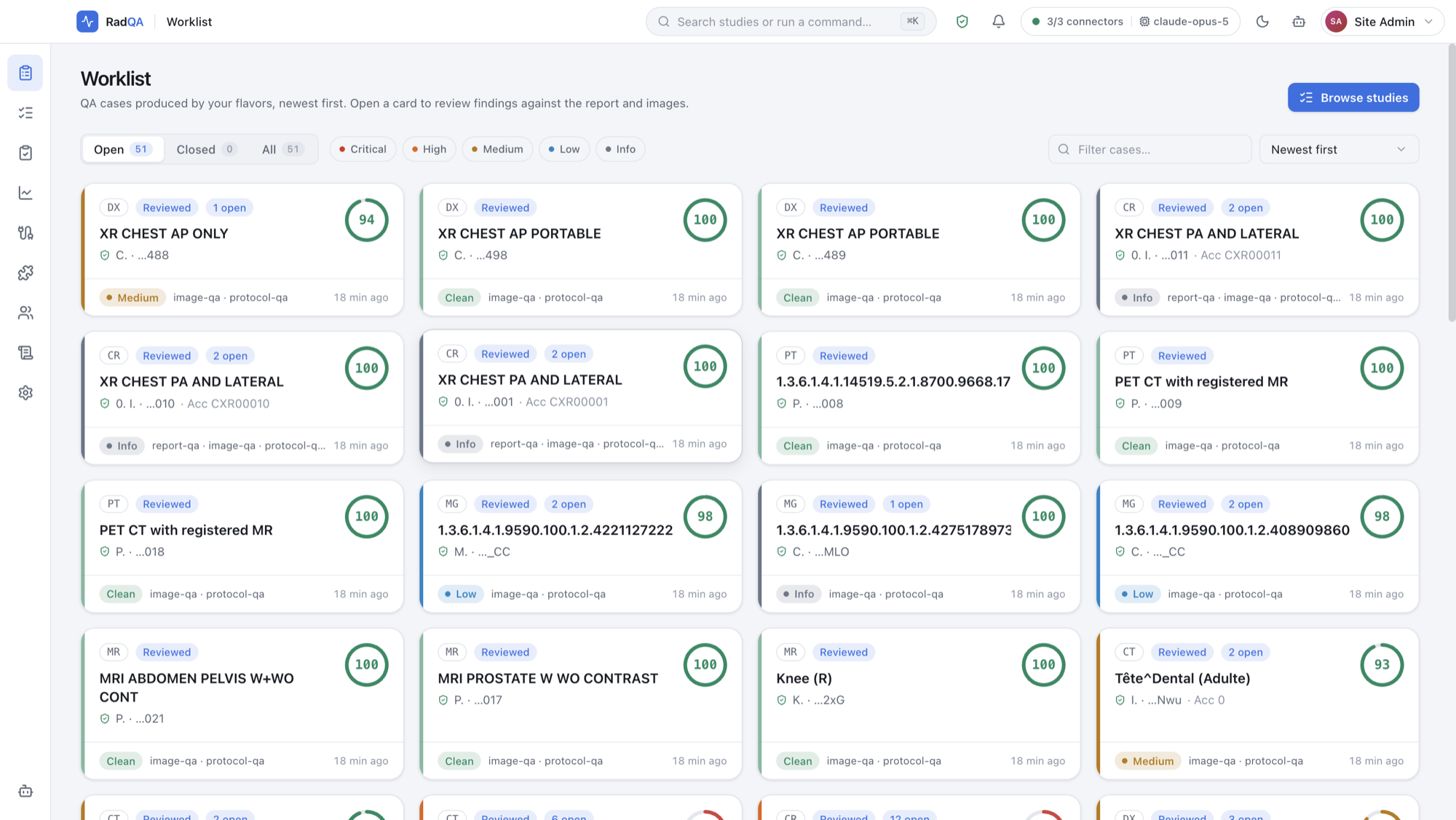
RadQA runs the same report QA and peer review sampling on every report, whoever wrote it. Analytics can be filtered by connector, so where outsourced reports arrive through their own feed you can compare turnaround against your targets, report QA findings and discrepancy rates side by side with in-house work, and export the results for contract meetings.
RadQA does not manage contracts or the relationship with a provider. RadQA is a pilot. It is a quality-assurance assistant, not a diagnostic device, and it does not replace radiologist reporting or clinical judgement.
 RadQA: AI quality assurance for radiologyWatch the demo on synthetic data, then see how it works →
Questions
What RCR guidance covers teleradiology?
Standards for the provision of teleradiology within the United Kingdom, second edition (December 2016), alongside the remote reporting section of the 2025 reporting standards.
Should teleradiologists be on the GMC specialist register?
The RCR's 2016 standards say teleradiologists reporting British patients should be on the GMC Clinical Radiology Specialist Register and indemnified to the same standard as the base organisation.
Who fixes a problem with an outsourced report?
The RCR's 2016 standards say the teleradiology company is responsible for addressing an issue the trust identifies, under a comprehensive contract.
Sources
Official pages, checked November 2026. Guidance changes, so check the current version before you rely on it.
- RCR: Standards for the provision of teleradiology within the United Kingdom, second edition (December 2016)
- CoR and RCR: Quality Standard for Imaging 2026, version 1.0
- RCR: Standards for interpretation and reporting of imaging investigations, 3rd edition (October 2025)
- RCR: NHS spent record £1.4bn on short-term fixes (May 2026)
General information for healthcare managers and clinical teams, checked November 2026. It is not legal, regulatory or clinical advice; follow the current official guidance and your organisation's own policies. No patient data is used in these examples. RadQA is a quality-assurance assistant for imaging departments. It is not a diagnostic device and does not replace radiologist reporting or clinical judgement. Validate against your own systems and local governance before production use.